Question
Explain the process of protein synthesis from processed mRNA.

Answer

Translation:

  • Translation is the process of synthesis of protein from mRNA with the help of ribosome.
  • A translational unit in mRNA from 5'→3' comprises of a start codon, region coding for a polypeptide, a stop codon and untranslated regions (UTRs) at both 5'-end and 3'-end for efficient process.

There are three stages of protein synthesis:

  1. Initiation:
  • Assembly of ribosome on mRNA.
  • Activation of amino acids and its delivery to tRNA.
  1. Elongation:
  • Repeated cycle of amino acid delivery.
  • Peptide bond formation and movement along the mRNA called translocation.
  1. Termination:
  • The release of a polypeptide chain.
  1. Initiation:
  • In prokaryotes, initiation requires the large and small ribosome subunits, the mRNA, initiation tRNA and three initiation factors (IFs).

  • Activation of amino acid: Amino acids become activated by binding with aminoacyl tRNA synthetase enzyme in the presence of ATP.

  • Transfer of amino acid to tRNA: The AA - AMP - Enzyme complex formed reacts with specific tRNA to form aminoacyl-tRNA complex. AA - AMP - Enzyme complex + tRNA → AA - tRNA + AMP + Enzyme.

  • The cap region of mRNA binds to the smaller subunit of ribosome.

  • The ribosome has two sites, A-site and P-site.

  • The smaller subunit first binds to the initiator mRNA and then binds to the larger subunit so that initiation codon (AUG) lies on the P-site.

  • The initiation tRNA, i.e., methionyl tRNA then binds to the P-site.

  1. Elongation of polypeptide chain:
  • Another charged aminoacyl tRNA complex binds to the A-site of the ribosome at the second codon.
  • A peptide bond is formed between carboxyl group (-COOH) of amino acid at P-site and amino group (-NH) of amino acid at A-site by the enzyme peptidyl transferase.
  • The ribosome slides over mRNA from codon to codon in the 5′ → 3′ direction.
  • According to the sequence of codons, amino acids are attached to one another by peptide bonds and a polypeptide chain is formed.
  1. Termination of polypeptide:
  • When the A-site of ribosome reaches a termination codon which does not code for any amino acid, no charged tRNA binds to the A-site.
  • Dissociation of polypeptide from ribosome takes place, which is catalysed by a 'release factor'.
  • There are three termination codons namely UGA, UAG and UAA.

Need a full question paper?

Generate a complete, print-ready paper with questions like this in minutes — across 16+ boards, with answer keys.

Start Generating Free

Similar questions

Describe in sequence the process of spermatogenesis in humans.
Explain the relationship of ribosomes, 1-RNA and m-RNA during the process of translation in Prokaryotes.
Give an account of Hershey and Chase experiment. What did it conclusively prove? If both DNA and proteins contained phosphorus and sulphur do you think the result would have been the same?
  1. What is meant by addictive disorder?
  2. Mention any two ways in which opiate narcotics affect human body.
  3. Name any two opiate narcotics.
A true breeding homozygous pea plant with green pods and axial flowers as dominant characters, is crossed with a recessive homozygous pea plant with yellow pods and terminal flowers. Work out the cross up to F2 generation giving the phenotypic ratios of F1 and F2 generation respectively.
The melding of a technique for repeated rounds of DNA synthesis with the discovery of a thermostable DNA polymerase has given scientists the very powerful technique known as polymerase chain reaction (PCR). PCR is based on three simple steps required for any DNA synthesis reaction: (1) denaturation of the template into single strands; (2) annealing of primers to each original strand for new strand synthesis; and (3) extension of the new DNA strands from the primers.
In the given figure, one cycle of polymerase chain reaction (PCR) is shown:
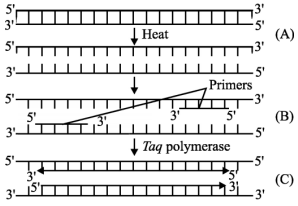
Image
i. Name the steps A, B and C.
ii. Give the purpose of each of these steps.
iii. State the contribution of Thermus aquaticus in this process.

Explain the difference between the following :
(i) Nucleoside and nucleotide
(ii) DNA and RNA
(iii) Codon and anticodon
(iv) Transcription and translation
(v) Inductive regulation and inhibitory regulation
(vi) RNA splicing and RNA editing
A particular garden pea plant produces only violet flowers.
  1. Is it homozygous dominant for the trait or heterozygous?
  2. How would you ensure its genotype? Explain with the help of crosses.
What are fossils? How many types of fossils are there? How will you determine the age of fossils?
Observe the representation of genes involved in the lac operon given below.

  1. Identify the region where the repressor protein will attach normally.
  2. Under certain conditions repressor is unable to attach at this site. Explain.
  3. If repressor fails to attach to the said site what products will be formed by z, y and a?
  4. Analyse why this kind of regulation is called negative regulation.