Question
Explain the process of thermonuclear fusion with example.

Answer

$\rightarrow$ When two light nuclei fuse to form a larger nucleus, energy is released, because binding energy increases during the process.
$\rightarrow$ Some examples of such energy liberating nuclear fusion reactions are :
${ }_1 H ^1+{ }_1 H ^1 \rightarrow{ }_1 H ^2+e^{+}+v+0.42 MeV$
${ }_1 H ^2+{ }_1 H ^2 \rightarrow{ }_2 He ^3+n+3.27 MeV$
${ }_1 H ^2+{ }_1 H ^2 \rightarrow{ }_1 H ^3+{ }_1 H ^1+4.03 MeV$
$\rightarrow$ In the first reaction, two protons combine to form a deuteron and a positron with a release of $0.42 MeV$ energy.
$\rightarrow$ In the second reaction, two deuterons combine to form the isotope of helium ${ }_2 He ^3$.
$\rightarrow$ In third reaction two deuterons combine to form a tritium and a proton. $4.03 MeV$ energy is released during this process.
$\rightarrow$ For a fusion to take place, the two nuclei must come close enough so that nuclear force is able to affect them.
$\rightarrow$ This force must be strong enough to overcome the repulsive barrier between two positively charged nuclei.
$\rightarrow$ The height of the barrier depends on the charges and radii of the two interacting nuclei.
$\rightarrow$ For example :
The barrier height for two protons is $\sim 400 keV$.
The temperature required for a proton to overcome this barrier is $T$ .
$\therefore \frac{3}{2} k T =400 keV$
$T =\frac{2 \times 400 \times 10^3 \times 1.6 \times 10^{-19}}{3 \times 1.38 \times 10^{-23}}$
$T =3 \times 10^9 K$
$\rightarrow$ When fusion is achieved by raising the temperature of the system so that particles have enough kinetic energy to overcome the Coulomb repulsive barrier, it is called thermo $-$ nuclear fusion.

Need a full question paper?

Generate a complete, print-ready paper with questions like this in minutes — across 16+ boards, with answer keys.
Start Generating Free

Similar questions

The half-life of a radioisotope is 10h. Find the total number of disintegrations in the tenth hour measured from a time when the activity was 1Ci.
The near point and the far point of a child are at 10cm and 100cm. If the retina is 2.0cm behind the eye-lens, what is the range of the power of the eye-lens?
A number of identical cells, n, each of emf E, internal resistance r connected in series are charged by a d.c. source of emf E', using a resistor R.
  1. Draw the circuit arrangement.
  2. Deduce the expressions for (a) the charging current and (b) the potential difference across the combination of the cells.
A transformer has 50 turns in the primary and 100 in the secondary. If the primary is connected to a 220V DC supply, what will be the voltage across the secondary?
What is the radius of curvature of the parabola traced out by the projectile in the previous problem at a point where the particle velocity makes an angle $\frac{\theta}{2}$ with the horizontal?
A monochromatic light source of power 5mW emits $8 \times 10^{15}$ photons per second. This light ejects photo electrons from a metal surface. The stopping potential for this set up is 2V. Calculate the work function of the metal.
Calculate the energy released by 1g of natural uranium assuming 200MeV is released in each fission event and that the fissionable isotope $^{235}U$ has an abundance of 0.7% by weight in natural uranium.
Current of 4 A is flowing in a straight wire AB. A proton $P$ is travelling parallel to the wire in the opposite direction of current with a speed of $4 \times 10^6$ $m / s$ at a distance of 0.2 m from the wire as shown in the diagram. Calculate the magnitude of force applied on the proton and also tells its direction.
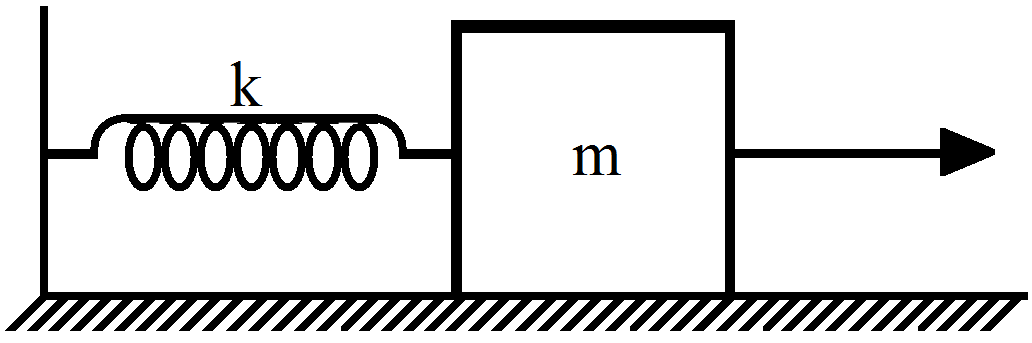
The spring shown in figure is unstretched when a man starts pulling on the cord. The mass of the block is M. If the man exerts a constant force F, find
  1. The amplitude and the time period of the motion of the block,
  2. The energy stored in the spring when the block passes through the equilibrium position and,
  3. The kinetic energy of the block at this position.
In a typical fission reaction, the nucleus is split into two middle-weight nuclei of unequal masses. Which of the two (heavier or lighter) has greater kinetic energy? Greater linear momentum?