Question
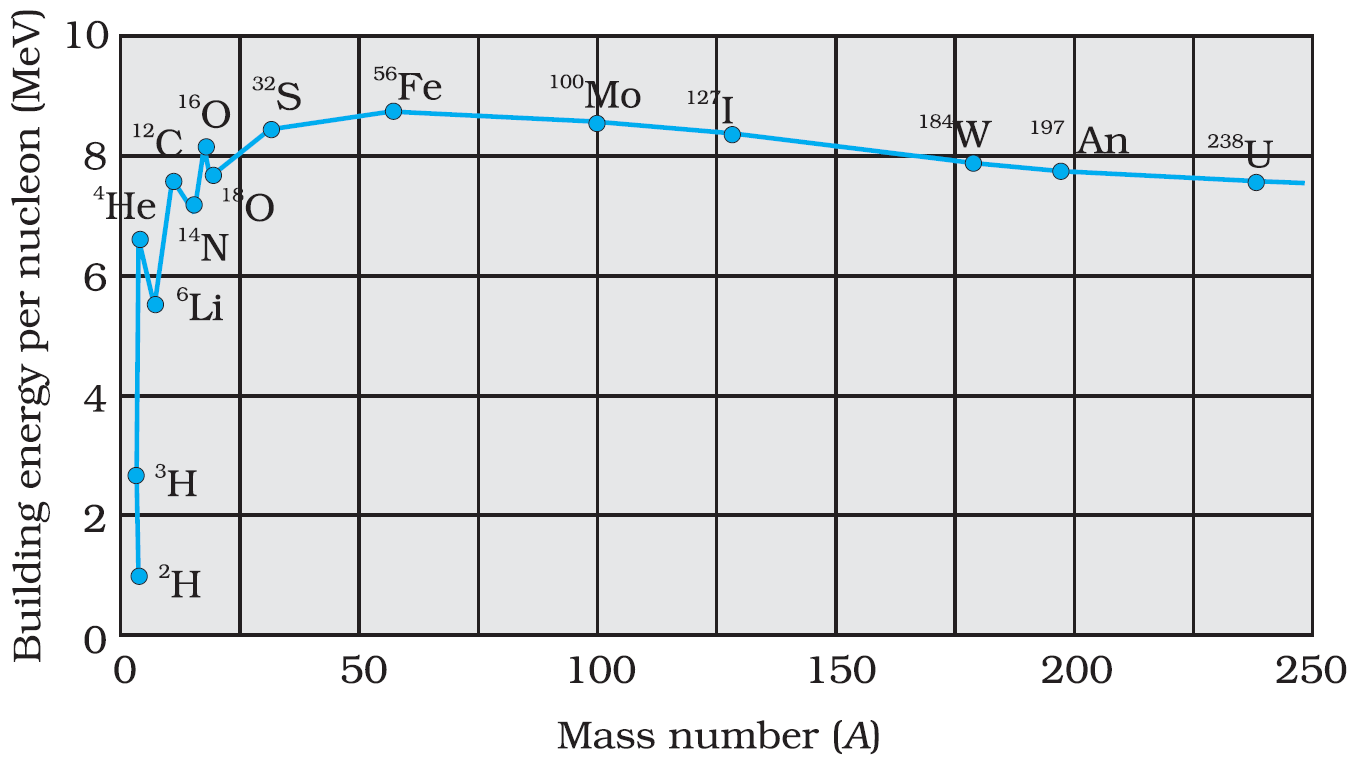
  1. Explain the processes of nuclear fission and nuclear fusion by using the plot of binding energy per nucleon (BE/ A) versus the mass number A.
  2. A radioactive isotope has a half-life of 10 years. How long will it take for the activity to reduce to 3·125%?
Answer

  1.  

Nuclear fission: Binding energy per nucleon is smaller for heavier nuclei (greater than 200) i.e., heavier nuclei are less stable. When a heavier nucleus splits into the lighter nuclei, they become stable, this happens in nuclear fission.
Nuclear fusion: The binding energy per nucleon is small for light nuclei (between 2 to 20), i.e., they are less stable. So when two light nuclei combine to form a heavier nucleus, the higher binding energy per nucleon of the latter results in the release of energy. This is what happens in a nuclear fusion.
  1. $\frac{\text{R}}{\text{R}_0}=\frac{\text{N}}{\text{N}_0}=\Big(\frac{1}{2}\Big)^{\text{n}}$
$\frac{\text{R}}{\text{R}_0}=3.125\%=\frac{3.125}{100}=\frac{1}{32}=\Big(\frac{1}{2}\Big)^5$
$=\Big(\frac{1}{2}\Big)^\text{n}=\Big(\frac{1}{2}\Big)^5\Rightarrow\ \text{n}=5$
$\text{t}=\text{nT}_{\frac{1}{2}}=5\times10=50\text{ year}$

Need a full question paper?

Generate a complete, print-ready paper with questions like this in minutes — across 16+ boards, with answer keys.

Start Generating Free

Similar questions

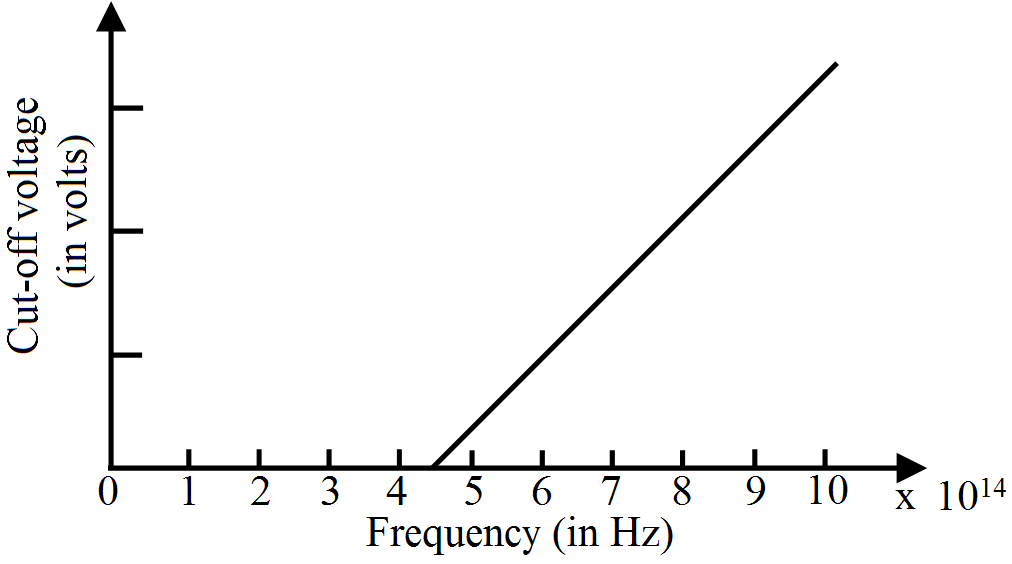
For photoelectric effect in sodium, the figure shows the plot of cut$-$off voltage versus frequency of incident radiation. Calculate,
  1. Threshold frequency.
  2. Work function for sodium.
The magnetic field at a point inside a 2.0mH inductor coil becomes 0.80 of its maximum value in 20µs when the inductor is joined to a battery. Find the resistance of the circuit.
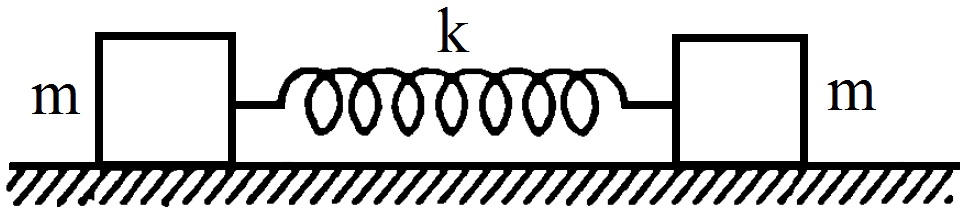
Consider the situation shown in figure Show that if the blocks are displaced slightly in opposite directions and released, they will execute simple harmonic motion. Calculate the time period.
An ac circuit is made from series combination of components of circuits X and Y . Current is ahead of voltage by $\frac{\pi}{4}$. If component $X$ is pure resistor whose value is $100 \Omega$ then (i) what is the name of component $Y$ ? (ii) If root mean square value of voltage is 141 V , then find the root mean square value of the current.
A simple pendulum of lerigth $1$ feet suspended from the ceiling of an elevator takes $\frac{\pi}{3}$ seconds to complete one oscillation. Find the acceleration of the elevator.
Explain with example, whether the neutron-proton ratio in a nucleus increases or decreases due to $\beta-$decay.
A sphere of mass $20\ kg$ is suspended by a metal wire of unstretched length $4m$ and diameter $1\ mm$. When in equilibrium, there is a clear gap of $2\ mm$ between the sphere and the floor. The sphere is gently pushed aside so that the wire makes an angle $\theta$ with the vertical and is released. Find the maximum value of $\theta$ so that the sphere does not rub the floor. Young's modulus of the metal of the wire is $2.0 \times 10^{11}\ N/m^2$. Make appropriate approximations.
Write symbolically the nuclear $\beta^{+}$decay process of  $^{11}_{6}\text{C}$ . Is the decayed product X an isotope or isobar of  $^{11}_{6}\text{C}$?
Given the mass values m $(^{11}_{6}\text{C})$ = 11·011434 u and m (X) = 11·009305 u. Estimate the Q-value in this process.
In a Young’s double$-$slit experiment, the slits are separated by $0.28\ mm$ and the screen is placed $1.4 m$ away. The distance between the central bright fringe and the fourth bright fringe is measured to be $1.2 \ cm.$ Determine the wavelength of light used in the experiment.
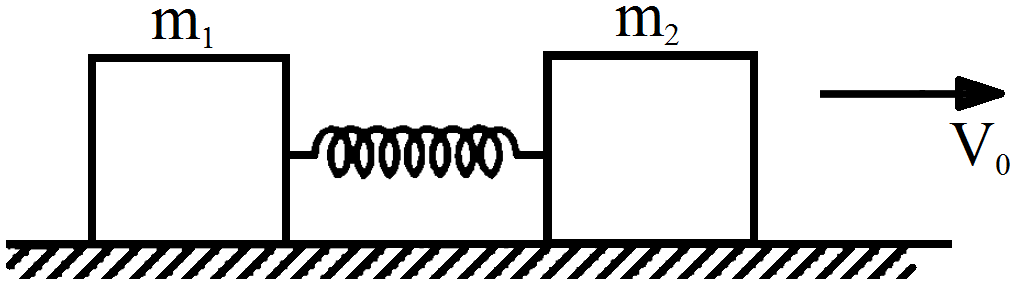
Two blocks of masses $m_1$ and $m_2$ are connected by a spring of spring constant $k.$ The block of mass $m_2$ is given a sharp impulse so that it acquires a velocity $v_0$ towards right. Find
  1. The velocity of the centre of mass.
  2. The maximum elongation that the spring will suffer.