Question
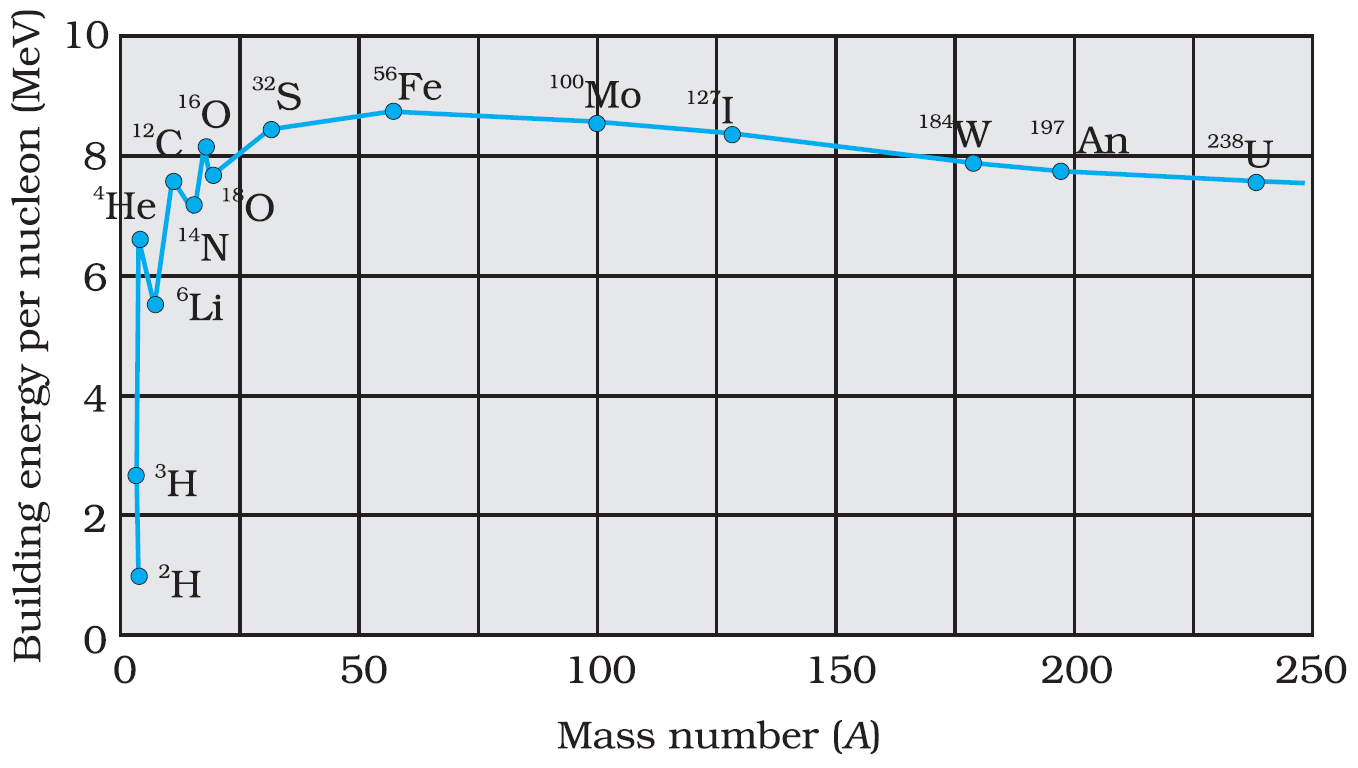
  1. Explain the processes of nuclear fission and nuclear fusion by using the plot of binding energy per nucleon (BE/ A) versus the mass number A.
  2. A radioactive isotope has a half-life of 10 years. How long will it take for the activity to reduce to 3·125%?

Answer

  1.  

Nuclear fission: Binding energy per nucleon is smaller for heavier nuclei (greater than 200) i.e., heavier nuclei are less stable. When a heavier nucleus splits into the lighter nuclei, they become stable, this happens in nuclear fission.

Nuclear fusion: The binding energy per nucleon is small for light nuclei (between 2 to 20), i.e., they are less stable. So when two light nuclei combine to form a heavier nucleus, the higher binding energy per nucleon of the latter results in the release of energy. This is what happens in a nuclear fusion.

  1. $\frac{\text{R}}{\text{R}_0}=\frac{\text{N}}{\text{N}_0}=\Big(\frac{1}{2}\Big)^{\text{n}}$

$\frac{\text{R}}{\text{R}_0}=3.125\%=\frac{3.125}{100}=\frac{1}{32}=\Big(\frac{1}{2}\Big)^5$

$=\Big(\frac{1}{2}\Big)^\text{n}=\Big(\frac{1}{2}\Big)^5\Rightarrow\ \text{n}=5$

$\text{t}=\text{nT}_{\frac{1}{2}}=5\times10=50\text{ year}$
Need a full question paper?

Generate a complete, print-ready paper with questions like this in minutes — across 16+ boards, with answer keys.

Start Generating Free

Similar questions

An infinitely long thin wire carrying a uniform linear static charge density λ is placed along the z-axis. The wire is set into motion along its length with a uniform velocity $\text{v}=\text{v}\hat{\text{k}}_\text{z}$. Calculate the poynting vector $\text{S}=\frac{1}{\mu_0}(\text{E}\times\text{B})$.

A particle starts from the origin, goes along the X-axis to the point (20m, 0) and then returns along the same line to the point (-20m, 0). Find the distance and displacement of the particle during the trip.
A charged capacitor of capacitance C is discharged through a resistance R. A radioactive sample decays with an average-life $\tau.$ Find the value of R for which the ratio of the electrostatic field energy stored in the capacitor to the activity of the radioactive sample remains constant in time.
Using Bohr's postulates, obtain the expression for the total energy of the electron in the stationary states of the hydrogen atom. Hence draw the energy level diagram showing how the line spectra corresponding to Balmer series occur due to transition between energy levels.
With the help of a circuit diagram, explain how two p-n junction diodes along with a centre tapped transformer can be used as a full wave rectifier.
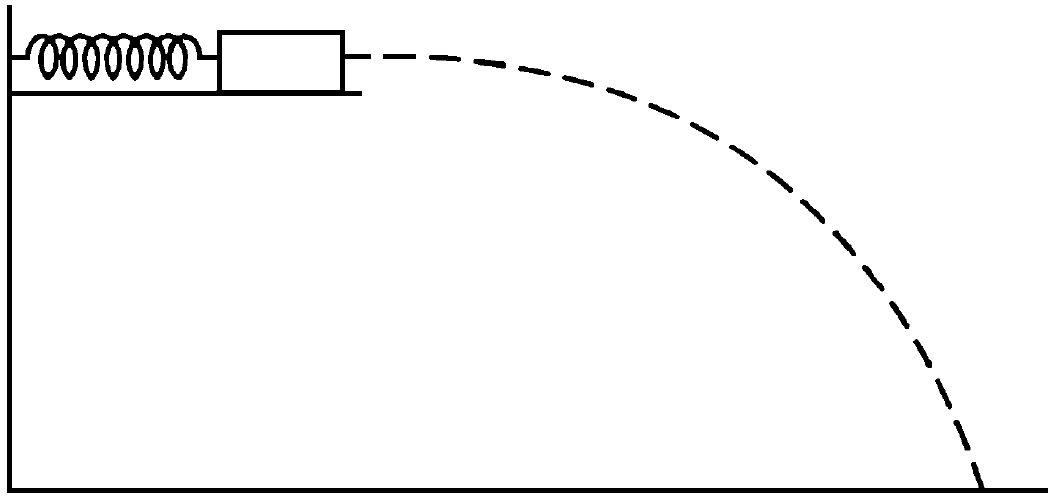
A small block of mass 100g is pressed against a horizontal spring fixed at one end to compress the spring through 5.0cm (figure). The spring constant is 100N/m. When released, the block moves horizontally till it leaves the spring. Where will it hit the ground 2m below the spring?

What conclusion can you draw about displacement current and conduction current?
  1. Distinguish between a conductor and a semi conductor on the basis of energy band diagram.
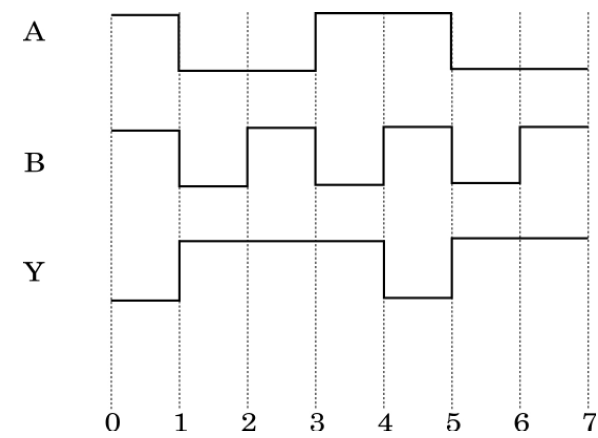
  2. The following figure shows the input waveforms (A, B) and the output waveform (Y) of a gate. Identify the gate, write its truth table and draw its logic symbol.

A semicircular rod is joined at its end to a straight rod of the same material and the same cross-sectional area. The straight rod forms a diameter of the other rod. The junctions are maintained at different temperatures. Find the ratio of the heat transferred through a cross section of the semicircular rod to the heat transferred through a cross section of the straight rod in a given time.
What is the parallel connection of cells ? Derive the formula for equivalent $e m f$ and equivalent internal resistance for parallel connection of cell.