Question
Explain the quantisation of angular momentum for an electron orbiting a nucleus.
Write second postulate of Bohr's model and De-Broglie's explanation of it.

Answer

$•$ Bohr's second postulate :
$\rightarrow$ An electron revolves around the nucleus only in those orbits for which the angular momentum is an integral multiple of $\frac{h}{2 \pi}$.
Where, $h$ is Planck's constant
$h=6.625 \times 10^{-34} JS$
$\rightarrow$ Thus the angular momentum of the electron
$L =\frac{n h}{2 \pi} $  Where, $n=1,2,3 \ldots \ldots$
$• De -$ Broglie's explanation :
$\rightarrow$ According to de $-$ Broglie's hypothesis even matter particles like electrons have wave nature. Its practical explanation was given by Davisson and Germer, from which de $-$ Broglie argued that the electron in its circular orbit must be seen as a particle wave.
$\rightarrow$ When the tensioned wire is plucked tied to a rigid support on both ends, a vast number of wavelengths are excited.
However only those wavelengths survive which have nodes at the ends and form the standing wave in the string. It means standing waves are formed when the total distance travelled by a wave down the string and back is one wavelength or any integral number of wavelength.
$\rightarrow$ Waves with other wavelengths interfere with themselves upon reflection and their amplitudes rapidly drop to zero.
$\rightarrow$ For an electron moving in $n^{\text {th }}$ circular orbit of radius $r_n$, the total distance is the circumference of the orbit. Thus,
$2 \pi r_n=n \lambda$
Where $n=1,2,3, \ldots \ldots .$.
$\rightarrow$​​​​​​​ But the de $-$ Broglie wavelength $\lambda=\frac{h}{p}$
Where $p =$ momentum of electron. If the speed of the electron is much less than the speed of light, the momentum is $= m v_{ n }$
$\therefore \lambda=\frac{h}{m v_n}$
$\rightarrow$​​​​​​​ Form equation $(1)$ and $(2)$,
$\therefore 2 \pi r_n=\frac{n h}{m v_n}$
$\therefore m v_n r_n=\frac{n h}{2 \pi}$
$\rightarrow$ This is the quantum condition proposed by Bohr for the angular momentum of the electron.
$\rightarrow$​​​​​​​ Thus, de $-$ Broglie hypothesis provided an explanation for Bohr's second postulate for the quantisation of angular momentum of the orbiting electron.

Need a full question paper?

Generate a complete, print-ready paper with questions like this in minutes — across 16+ boards, with answer keys.
Start Generating Free

Similar questions

Draw a schematic arrangement for winding of primary and secondary coils in a transformer with the two coils on separate limbs of the core. State its underlying principle and find the relation between the primary and secondary voltages in terms of the number of turns of the primary and secondary windings. How are the currents in the primary and secondary coils related to the voltages in the case of an ideal transformer?
(i) Define rectification.
(ii) Draw circuit diagram of a full-wave rectifier.
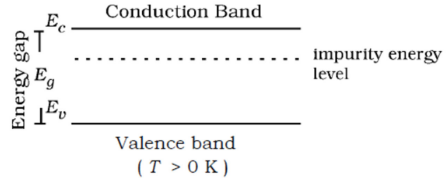
(iii) Semi-conductor related to given energy band diagram is:
n-type semi-conductor, p-type semi-conductor or intrinsic semiconductor.
Image
  1. Write three characteristic properties of nuclear force.
  2. Draw a plot of potential energy of a pair of nucleons as a function of their separation. Write two important conclusions that can be drawn from the graph.
What is electromagnetic wave ? On which factors does its velocity in vacuum depend ?
Establish a relation between resistance and resistivity of any substance. Explain in detail, the dependence of resistivity on the temperature.
A person standing on a road sends a sound signal to the driver of a car going away from him at a speed of 72km/h. The signal travelling at 330m/s in air and having a frequencyof 1600Hz gets reflected d from the body of the car and returns. Find the frequency of the reflected signal as heard by the person.
State the underlying principle of a cyclotron. Explain its working with the help of a schematic diagram. Obtain the expression for cyclotron frequency.
How does the resolving power of a compound microscope get affected on:
  1. Decreasing the diameter of its objective?
  2. Increasing the focal length of its objective?
A semiconducting material has a band gap of 1eV. Acceptor impurities are doped into it which create acceptor levels 1meV above the valence band. Assume that the transition from one energy level to the other is almost forbidden if kT is less than $\frac{1}{50}$ of the energy gap. Also, if kT is more than twice the gap, the upper levels have maximum population. The temperature of the semiconductor is increased from 0K. The concentration of the holes increases with temperature and after a certain temperature it becomes approximately constant. As the temperature is further increased, the hole concentration again starts increasing at a certain temperature. Find the order of the temperature range in which the hole concentration remains approximately constant.
The kinetic energy of a charged particle decreases by 10J as it moves from a point at potential 100V to a point at potential 200V. Find the charge on the particle.