Question
Explain the reason for capillarity and mention some practical examples based on capillarity.
Answer

SELF

Need a full question paper?

Generate a complete, print-ready paper with questions like this in minutes — across 16+ boards, with answer keys.

Start Generating Free

Similar questions

Explain in detail the Kepler's three laws related to planetary motion.
(i) What is coupled oscillation? Show various examples of these in the picture.
(ii) Explain the motion of two coupled simple harmonic oscillators.
You are riding in an automatic vehicle of mass 3000 kg . Assume that you are testing the oscillatory characteristics of the suspension system of this vechicle when the entire vehicle is placed on it, the suspended is inclined by 15 cm . Also, the amplitude of oscillation decreases by $50 \%$ in the period of one complete oscillation. Estimate the value of the following
(a) spring constant, and
(b) for the shock absorber system of a spring and $a$ wheel damping constant $b$.
Assume that each wheel carries a mass of 750 kg is.
Show that for a particle in linear S.H.M., the average kinetic energy over a period of oscillation is equal to the average potential energy over the same period. At what distance from the mean position is the kinetic energy in simple harmonic oscillator equal to potential energy?
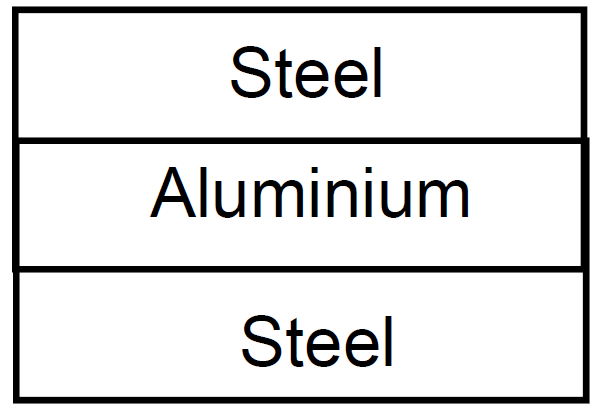
Two steel rods and an aluminium rod of equal length l0 and equal cross section are joined rigidly at their ends as shown in the figure below. All the rods are in a state of zero tension at 0°C. Find the length of the system when the temperature is raised to $\theta$. Coefficient of linear expanaion of aluminium and steel are $\alpha_\text{a}$ and $\alpha_\text{s}$respectively. Young's modulus of aluminium is Ya and of steel is Ys.

A capacitor of capacitance $12.0\mu\text{F}$ is connected to a battery of emf 6.00V and internal resistance $1.00\Omega$ through resistanceless leads. $12.0\mu\text{s}$ after the connections are made, what will be (a) the current in the circuit (b) the power delivered by the battery (c) the power dissipated in heat and (d) the rate at which the energy stored in the capacitor is increasing.
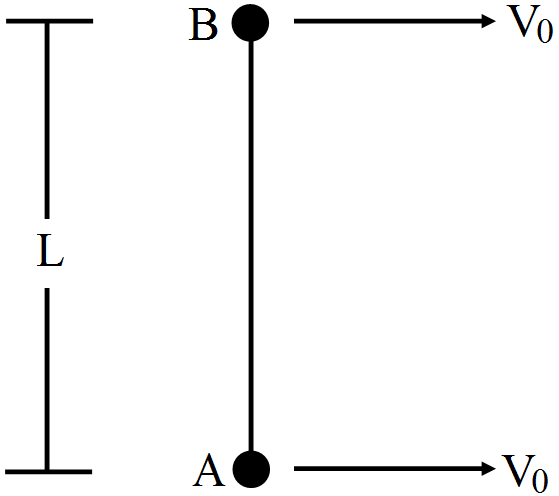
Two small balls A and B, each of mass m, are joined rigidly to the ends of a light rod of lengh L (figure). The system translates on a frictionless horizontal surface with a velocity vo in a direction perpendicular to the rod. A particle P of mass m kept at rest on the surface sticks to the ball A as the ball collides with it. Find:
  1. The linear speeds of the balls A and B after the collision.
  2. The velocity of the centre of mass C of the system A + B + P.
  3. The angular speed of the system about C after the collision.

[Hint: The light rod will exert a force on the ball B only along its length.]
  1. State the laws of limiting friction.
  2. Calculate the amount of work done in moving a body up a rough inclined plane. (The object is moved very slowly.)

OR

  1. Why has a horse to pull a cart harder during the first few steps of its motion?
  2. How does banking of roads reduces wear and tear of the tyres?
  3. Find the maximum speed at which a car can take turn round a curve of 30m radius on a level road, if the coefficient of friction between tyres and road is 0.4. (g = 10ms-2)
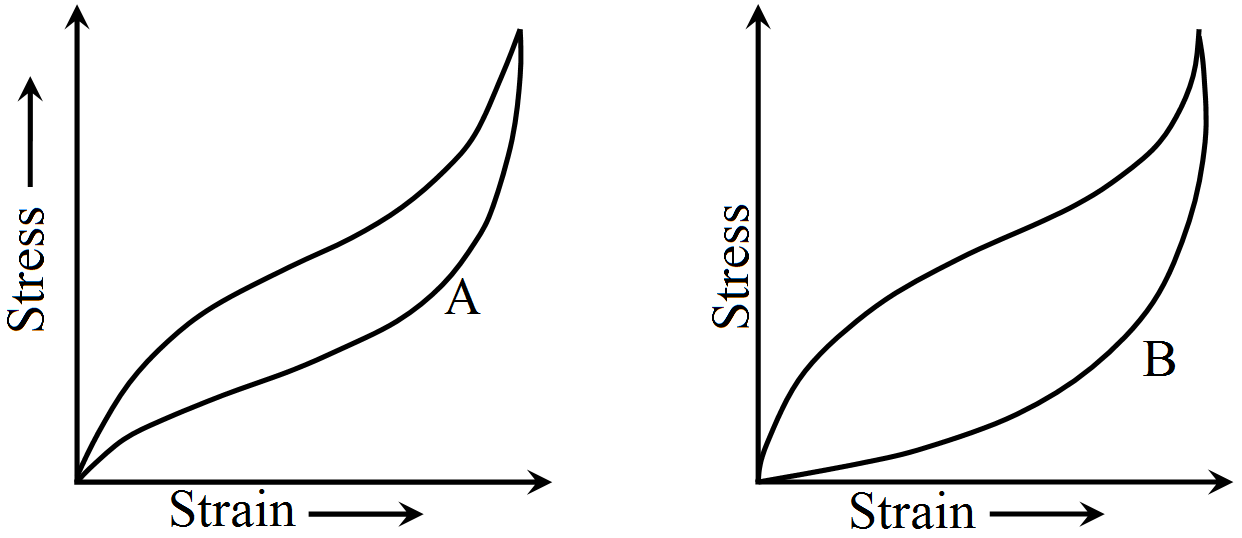
For two different type of rubber stress - strain curves are shown:

  1. To make a shock absorber which rubber will you prefer and why?
  2. To make car tyre which of the two rubber would you prefer and why?
Estimate the fraction of molecular volume to the actual volume occupied by oxygen gas at STP. Take the diameter of an oxygen molecule to be $3\mathring{\text{A}}$