Question
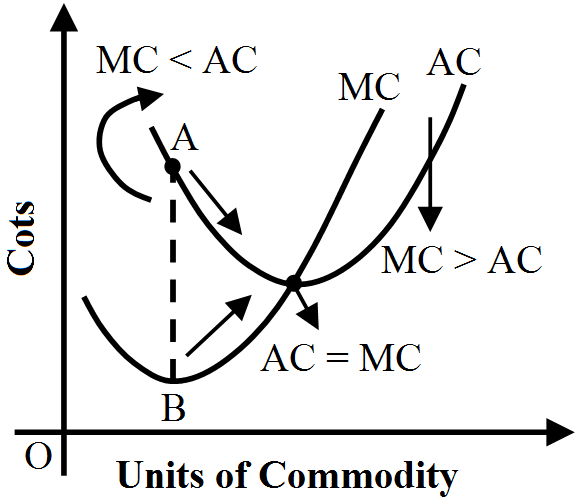
Explain the relationship between AC and MC with the help of a diagram.
Answer

  1. As long as MC is below AC, AC curve falls till their intersection at point E.
  2. When MC curve comes to fall, it falls more rapidly than AC curve and reaches its minimum point B earlier than the AC curve reaches its minimum point E. Therefore, MC curve is rising from B to E whereas AC curve is still falling from A to E.
  3. When MC curve is rising, it cuts the AC curve at its minimum point E and after that point MC is above than AC.

Need a full question paper?

Generate a complete, print-ready paper with questions like this in minutes — across 16+ boards, with answer keys.

Start Generating Free

Similar questions

Compare between monopoly and monopolistic competition.
When the price of X doubles, its quantity demanded falls by 60 percent. Calculate its price elasticity of demand. What should be the percentage change in price so that its quantity demanded doubles?
What are the conditions of consumer’s equilibrium under the indifference curve approach? What changes will take place if the conditions are not fulfilled to reach equilibrium?
Market of a good is in equilibrium. If the demand for the good 'decreases'. Explain the chain of effects of this change.
Explain the equilibrium level of income with the help of saving and investment curves. If savings exceed planned investment, what changes will bring about the equality between them?

OR

Explain with the help of a diagram and using Saving = Investment approach the determination of equilibrium output and income level in an economy. What happens when the economy is not in equilibrium and saving exceeds investment?

Explain feature (implication) of large number of sellers and buyers' in perfect competition.

OR

Explain the implications of large number of sellers in a perfectly competitive market.

OR

Explain the implications of large number of buyers in a perfectly competitive market.

Complete the following table:
Output (units) Average Fixed Cost (AFC) (₹) Marginal Cost (MC) (₹) Total Cost (TC) (₹)
1 __ __ 72
2 __ 10 82
3 20 8 __
4 __ __ 99
5 12 10 __
Explain the implications of the following in a perfectly competitive market:
  1. Large number of buyers.
  2. Freedom of entry and exit to firms.
Distinguish between perfect oligopoly and imperfect oligopoly. Also explain the "interdependence between the firms" feature of oligopoly.
In the above example, if exports change to X = 100, find the change in equilibrium income and the net export balance.