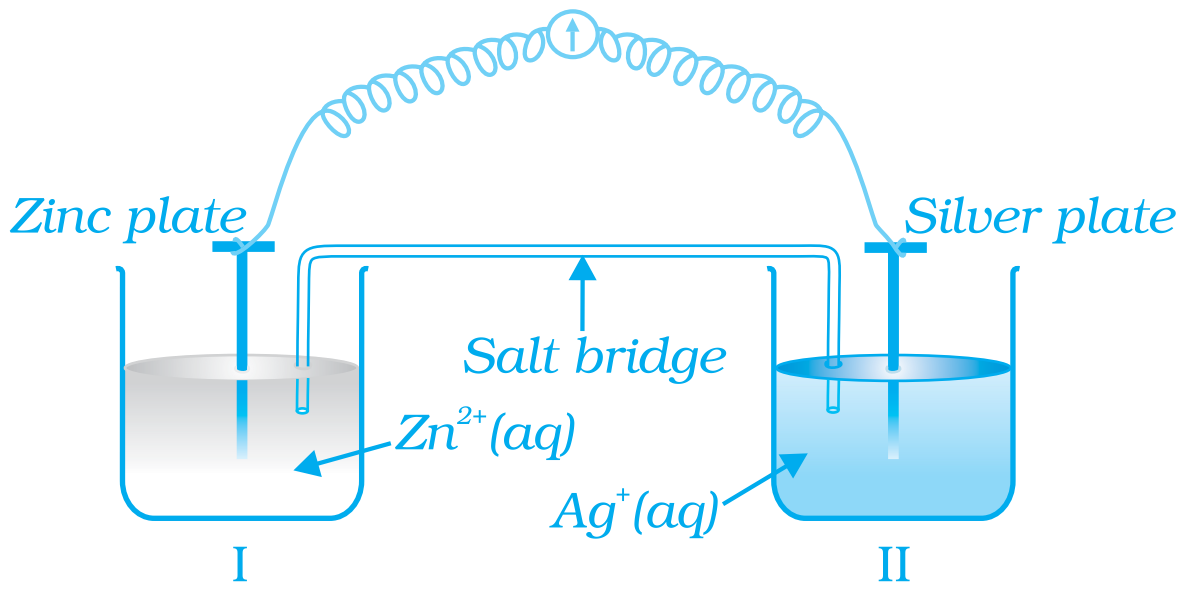
Question
Explain the relationship between $\Delta G$ and $E _{\text {cell }}^{\circ}$ with the help of an example.

Answer

self

Need a full question paper?

Generate a complete, print-ready paper with questions like this in minutes — across 16+ boards, with answer keys.

Start Generating Free

Similar questions

Explain primary, secondary and tertiary structure of proteins with diagram.
Match the items of Column I and Column II.
  Column I   Column II
(i) Mathematical expression for rate of reaction. (a) Rate constant.
(ii) Rate of reaction for zero order reaction is equal to. (b) Rate law.
(iii) Units of rate constant for zero order reaction is same as that of. (c) Oder of slowest step.
(iv) Order of a complex reaction is determined by. (d) Rate of a reaction.
The time required for 10% completion of a first order reaction at 298 K is equal to that required for its 25% completion at 308 K. If the value of A is 4 × 10¹⁰ s-1 Calculate k at 318 K and Ea.
With the help of an example explain what is meant by pseudo first order reaction.
Write equations of the following reactions :
(i) Friedel Crafts reaction-alkylation of anisole.
(ii) Nitration of anisole.
(iii) Bromination of anisole in ethanoic acid medium.
(iv) Friedel Crafts acetylation of anisole.
Complete the following reactions :
(i) $C _6 H _5 NH _2+ CHCl _3+$ alc. $KOH \longrightarrow$
(ii) $C _6 H _5 N_2 Cl + H _3 PO _2+ H _2 O \longrightarrow$
(iii) $C _6 H _5 NH _2+ H _2 SO _4$ (conc.) ⟶
(iv) $C _6 H _5 N_2 Cl + C _2 H _5 OH \longrightarrow$
(v) $C _6 H _5 NH _2+ Br _2(a q) \longrightarrow$
  1. Why do transition elements show variable oxidation states?
  1. Name the element showing maximum number of oxidation states among the first series of transition metals form Sc (Z=21) to Zn (Z=30).
  2. Name the element which shows only +3 oxidation state.
  1. What is lanthanoid contraction? Name an important alloy which contains some of the lanthanoid metals.
(a) (i) Write the disproportionation reaction of $H _3 PO _3$.
(ii) Draw the structure of $XeF _4$.
(b) Account for the following:
(i) Although fluorine has less negative electron gain enthalpy yet $F_2$ is a strong oxidizing agent.
(ii) Acidic character decreases from $N _2 O _3$ to $Bi _2 O _3$ in group 15.
(c) Write a chemical reaction to test Sulphur dioxide gas. Write the chemical equation involved.
A colourless substance 'A' (C6H7N) is sparingly soluble in water and gives a water soluble compound 'B' on treating with mineral acid. On reacting with CHCl3 and alcoholic potash 'A' produces an obnoxious smell due to the formation of compound 'C'. Reaction of 'A' with benzenesulphonyl chloride gives compound 'D' which is soluble in alkali. With NaNO2 and HCl, 'A' forms compound 'E' which reacts with phenol in alkaline medium to give an orange dye 'F'. Identify compounds 'A' to 'F'.