Question
Explain the representation of AC current and voltage by rotating vectors. (phasors).

Answer

→In an AC circuit in order to show the phase relationship between voltage and current the notion of phasor is used.
→A phasor is a vector, which is used to represent periodically changing quantities in the form of vectors.
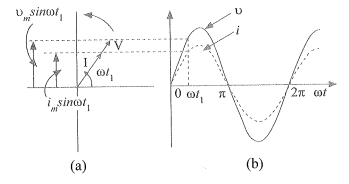
→For example to draw a phasor representing voltage $V =v_m \sin \omega t$, draw a vector of magnitude equal to $v_m$ and in the direction making an angle $\omega t$ with the horizontal axis.
→As time increases, value of $\omega t$ goes on increasing and the phasor (vector) rotates in anticlockwise direction accordingly. And its instantaneous value also keeps changing.
Image
→The voltage and current phasor shown in the fig. rotates about the origin with angular speed $\omega$. The vertical components of $\vec{V}$ and $\vec{I}$ represent the sinusoidally varying quantities $v$ and $i$.The magnitudes of phasors $\vec{V}$ and $\vec{I}$ represent the amplitudes (/peak values $v_m$ and $i_m$ ) of these oscillating quantities.
Image
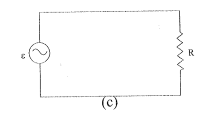
→Fig. (a) shows the voltage and current phasors and their relationship at time $t_1$ for the case of an AC source connected to a resistor. (fig. c)
→The projection of voltage and current phasors on vertical axis, i.e. $v_m \sin \omega t_1$, and $i_m \sin \omega t_1$ respectively represent the value of voltage and current at that instant.
→As shown in fig. (a), phasors $\vec{V}$ and $\vec{I}$ for the case of a resistor are in the same direction.
This means that phase angle(/phase difference) between the voltage and current is zero.

Need a full question paper?

Generate a complete, print-ready paper with questions like this in minutes — across 16+ boards, with answer keys.
Start Generating Free

Similar questions

A barometer tube is 80cm long (above the mercury reservoir). It reads 76cm on a particular day. A small amount of water is introduced in the tube and the reading drops to 75.4cm. Find the relative humidity in the space above the mercury column if the saturation vapour pressure at the room temperature is 1.0cm.
A ray PQ incident normally on the refracting face BA is refracting in the prism BAC made of material of refractive index1.5. Complete the path of ray through the prism. From which face will the ray emerge? Justify your answer.
Two wires A and B are made up of same material. Their areas of cross-section is same and ratio of their lengths is $2: 1$. If same potential difference is applied across the ends of lengths of each wire, then what will be the ratio of current flowing in the two wires?
How does the power of a convex lens vary, if the incident red light is replaced by violet light?
The equation $\omega=\frac{\mu_\text{v}-\mu_\text{r}}{\mu-1}$ asderived for a prism having small refracting angle. Is it also valid for a prism of large refracting angle? Is it also valid for a glass slab or a glass sphere?
The given graph shows the variation of charge $q$ versus potential difference $V$ for two capacitors $C_1$ and $C_2.$ The two capacitors have same plate separation, but the plate area of $C_2$ is double than that of $C_1.$ Which of the lines in the graph correspond to $C_1$ and $C_2$ and why?
Suppose, in certain conditions only those transitions are allowed to hydrogen atoms in which the principal quantum number n changes by 2. (a) Find the smallest wavelength emitted by hydrogen. (b) List the wavelength emitted by hydrogen in the visible range (380nm to 780nm).
A voltage of 30 V is applied across a carbon resistor with first, second and third rings of blue, black and yellow colours respectively. Calculate the value of current, in mA, through the resistor.
A body builder exerts a force of 150N against a bullworker and compresses it by 20cm. Calculate the spring constant of the spring in the bullworker.
The plates of a parallel-plate capacitor are made of circular discs of radii 5.0cm each. If the separation between the plates is 1.0mm, what is the capacitance?