→We can take any two rays emanating from a point on an object, trace their paths, find their point of intersection and thus obtain the image of the point due to reflection at a spherical mirror.
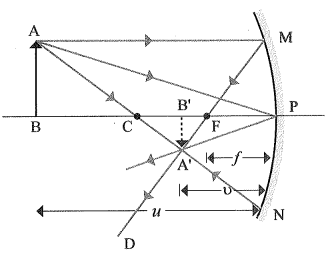
→In practice, however it is convenient to choose any two of the following rays:
→(i) Rays incident parallel to the principal axis are reflected and goes through the focus of the mirror.
(ii) The ray passing through the centre of curvature of a concave mirror or appearing to pass through it for a convex mirror. The reflected ray simply retraces the path.
(iii) The ray passing through the focus of the concave mirror or appearing to pass through the focus of a convex mirror. The reflected ray is parallel to the principal axis.
(iv) The ray incident at any angle at the pole (P). The reflected ray follows laws of reflection.