Question
Explain the rules for obtaining image due to reflection from a spherical mirror.

Answer

→We can take any two rays emanating from a point on an object, trace their paths, find their point of intersection and thus obtain the image of the point due to reflection at a spherical mirror.
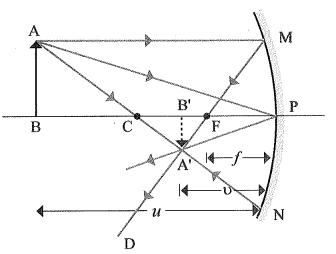
Image
→In practice, however it is convenient to choose any two of the following rays:
→(i) Rays incident parallel to the principal axis are reflected and goes through the focus of the mirror.
(ii) The ray passing through the centre of curvature of a concave mirror or appearing to pass through it for a convex mirror. The reflected ray simply retraces the path.
(iii) The ray passing through the focus of the concave mirror or appearing to pass through the focus of a convex mirror. The reflected ray is parallel to the principal axis.
(iv) The ray incident at any angle at the pole (P). The reflected ray follows laws of reflection.
Need a full question paper?

Generate a complete, print-ready paper with questions like this in minutes — across 16+ boards, with answer keys.

Start Generating Free

Similar questions

Answer the following question:
You have learnt that plane and convex mirrors produce virtual images of objects. Can they produce real images under some circumstances? Explain.
A Galilean telescope is 27cm long when focused to form an image at infinity. If the objective has a focal length of 30cm, what is the focal length of the eyepiece?
The radius of a planet is R1 and a satellite revolves round it in a circle of radius R2. The time period of revolution is T. Find the acceleration due to the gravitation of the planet at its surface.
A railroad car of mass M is at rest on frictionless rails when a man of mass m starts moving on the car towards the engine. If the car recoils with a speed v backward on the rails, with what velocity is the man approaching the engine?
If work function of caesium metal is 2.14 eV , then calculate its threshold frequency.
A potential difference $V$ is applied across the ends of a conductor of length $L$ and diameter $D$. What will be the effect on drift velocity of charge carriers in the conductor when (i) V is made half (ii) L is doubled and (iii) D is made half?
You are standing with your bag in your hands, on the ice in the middle of a pond. The ice is so slippery that it can offer no friction. How can you come out of the ice?
A potential difference of 12 volt is applied across the ends of 0.24 m long conductor. Calculate the drift velocity of the electrons. Mobility of electron is $5.6 \times 10^{-6} m^2 V^{-1} s^{-1}$.
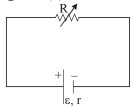
A variable resistor R, electromotive force and internal resistance $r$ are joined as shown in the given figure across the ends of the cell. Draw graph to show (i) terminal voltage and (ii) current $I$ as a function of $R$.
Image