Question
Explain the Rutherford atomic model and its limitations.

Answer

→Rutherford suggested that negatively charged electron revolves around the central nucleus just like the planets revolve around the sun.
→In a planetary system, the planets are held together by the gravitational force, while in an atom the electrons around the nucleus are held together by the Coulomb force.
Limitations :
→An object which moves in a circular path is being constantly accelerated. This acceleration is called centripetal acceleration.
→According to classical electromagnetic theory, an accelerating charged particle emits radiation in the form of electromagnetic waves. Therefore the energy of an accelerating electron should continuously decrease.
→The electron would spiral inward and eventually fall into the nucleus. Thus, such an atom can not be stable.
→According to the classical electromagnetic theory, the frequency of the electromagnetic waves emitted by the revolving electrons is equal to the frequency of revolution.
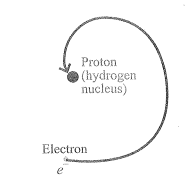
Image
→As the electrons spiral inwards, their angular velocities and their frequencies would change continuously, so the frequency of the light emitted also changes. Thus, they would emit a continuous spectrum, opposite to the line spectrum actually observed.
Need a full question paper?

Generate a complete, print-ready paper with questions like this in minutes — across 16+ boards, with answer keys.

Start Generating Free

Similar questions

A small town with a demand of 800kW of electric power at 220V is situated 15km away from an electric plant generating power at 440V. The resistance of the two wire line carrying power is 0.5Ω per km. The town gets power from the line through a 4000-220V step-down transformer at a sub-station in the town.
  1. Estimate the line power loss in the form of heat.
  2. How much power must the plant supply, assuming there is negligible power loss due to leakage?
  3. Characterise the step up transformer at the plant.
Write the formula to determine the refractive index of the material of the prism in the case of minimum deviation.
A 100Ω resistor is connected to a 220V, 50Hz ac supply.
  1. What is the rms value of current in the circuit?
  2. What is the net power consumed over a full cycle?
Explain threshold frequency.
A copper wire of diameter 1.6 mm carries 20A. Find the maximum magnitude of the magnetic field $\overrightarrow{\text{B}}$ due to this current.
The net charge in a current-carrying wire is zero. Then, why does a magnetic field exert a force on it?
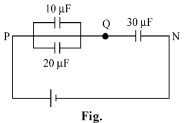
Find the equivalence between points $P$ and N of the combination shown in the figure.
Image
Find the maximum potential difference which may be applied across an X-ray tube with tungsten target without emitting any characteristic K or L X-ray. The energy levels of the tungsten atom with an electron knocked out are as follows.
Cell containing vacancy
K
L
M
Energy in keV
69.5
11.3
2.3
Complete the following decay schemes.
  1. $\text{ }^{226}_{88}\text{Ra}\rightarrow\alpha+$
  2. $\text{ }^{19}_8\text{O}\rightarrow\text{ }^{19}_9\text{F}+$
  3. $\text{ }^{25}_{13}\text{Al}\rightarrow\text{ }^{25}_{12}\text{Mg}+$
An electron and a proton are brought nearer; how does the potential energy of system change?