Question
Explain the significance of comparative financial statements.

Answer

The importance of comparative statements can be described as under:
$(1)$ Intrafirm Comparison:
  • When the accounts of business entity of current year are compared with the accounts of previous years, it is known as intrafirm comparison.
  • Moreover, when one business entity has various departments, their financial performance evaluation is also done.
$(2)$ Interfirm Comparison:
  • When financial statements of various business entities are compared with each other it is known as interfirm comparison.
  • With this comparison which business unit is financially strong or weak as compared to the other business unit can be ascertained and based on this investors may rethink on their investments decisions.
$(3)$ Indicates Trend:
  • Due to comparison of financial statements of different years and different sections of a business unit the information of trend pertaining to financial position and profitability is ascertained which helps to make decision of investment.
$(4)$ Useful to creditors:
  • Creditors of business units are of long term and short term Creditors determine credit worthiness of business units through analysis of financial statements so it is useful to creditors

Need a full question paper?

Generate a complete, print-ready paper with questions like this in minutes — across 16+ boards, with answer keys.
Start Generating Free

Similar questions

Write short note: Realisation account.
State whether the following are true or false. Ractify the false statement:
$(1)$ Goodwill is not recorded in the books of the firm, but at the time of dissolution $20,000$ has been realised for it, then it is compulsory to record it in the books now.
$(2)$ Liability of the partners of the partnership firm is unlimited.
$(3)$ At the time of dissolution unrecorded debts are not to be paid back.
Daksha, Sanjana and Rutva are the partners of a partnership firm. Profit-loss sharing ratio between them in $5: 3: 2$. The following are the balances in the books of the firm as on $31-3-2019.$
$(1)$ Capital reserve $₹ 50,000$
$(2)$ Research and development expense $₹ 75,000$
$(3)$ Investment fluctuation fund $₹ 10,000$
$(4)$ Workers saving account $₹ 20,000$
On the above date, Daksha, Sanjana and Rutva decided to change their profit-loss ratio to $2: 2: 1$. Pass necessary journal entries showing distribution of accumulated profit or losses in the books of the firm.
Distinguish between shares and debentures.
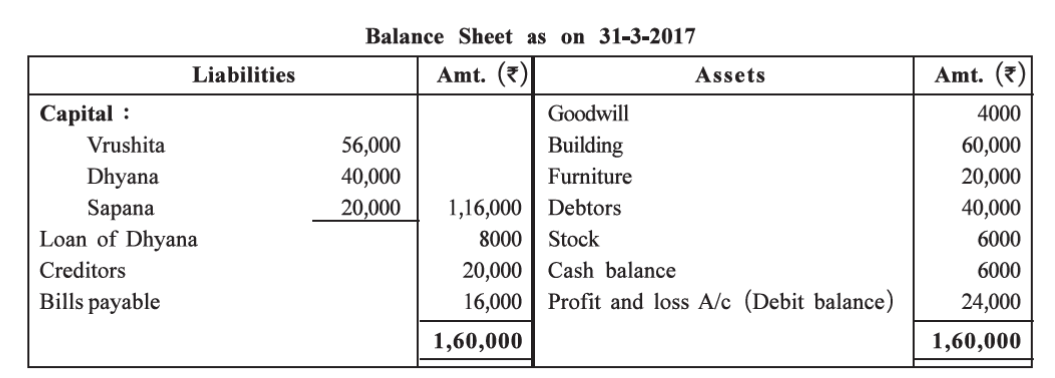
Vrushita, Dhyana and Sapana are partners sharing profit-loss in equal proportion. On $31-3-2017$ partners have decided to dissolve the firm. Balance sheet of that day is given.

Disposal of assets and liabilities is as follows:
$(1)$ Vrushita has taken building for $₹ 52,000$ and accepted to pay for bills payable.
$(2)$ Sapana has taken stock for $₹ 8000.$
$(3)$ Realised $₹ 16,000$ for furniture.
$(4)\ ₹ 36,000$ collected from debtors.
$(5)$ Dissolution expense incurred $₹ 6000.$
$(6)$ Paid for unrecorded stationery bill of $₹ 2000.$
$(7)$ Bad debts of $₹ 4000$ was written off in past, out of which $₹ 2000$ received.
$(8)$ No value is realised for goodwill.
As per partnership act, deficit of any partners' capital is to be paid immediately in cash by the partners'. Prepare necessary accounts for dissolution accounts.
Poonam, Chandni and Komal are the partners in a firm. Their profit and loss sharing ratio is $3: 2: 1$. All the partners have decided to change the profit and loss ratio and it is $1: 2: 2$. Calculate the sacrificing ratio of partners.
Give accounting treatments for goodwill of different circumstances when firm goes for dissolution.
$S, E, B$ and $I$ are the partners sharing profits in the ratio of $4:3:2:1.\ B$ and $I$ retires. $B's$ share is acquired by $S$ and $I's$ share is acquired by $E.$ Find out the new profit and loss sharing of $S$ and $E.$
$M, N$ and $O$ are the partners sharing profit and loss in the ratio of $4:3:2.$ Calculate new profit-loss sharing ratio under the following circumstances, if
$(i)\ M$ retires
$(ii)\ N$ retires
$(iii)\ O$ retires
Total assets are $Rs.1,50,000$ of firm $A$ and $B$ where cash of $Rs.10,000$ is included. Net assts of the firm are $Rs.1,00,000.$ The ratio of capital and reserve is $4:1.$ The capital of $A$ is more then of $B$ by $Rs.20,000.$ Loss of realisation account is $Rs.20,000.$ Firm is dissolved. Prepare opening balance sheet and ascertain opening capital of $A$ and $B.$