Question
Explain the solubility rule “like dissolves like” in terms of intermolecular forces that exist in solutions.

Answer

A substance dissolves in a solvent if the intermolecular interactions are similar in both the components.
For example: Polar solutes dissolve in polar solvents and non-polar solutes in non-polar solvents. Thus, we can say “like dissolves like”.

Need a full question paper?

Generate a complete, print-ready paper with questions like this in minutes — across 16+ boards, with answer keys.

Start Generating Free

Similar questions

Explain why p-nitrophenol is more acidic than phenol.
What is ionic conductivity? It depends on which factor?
When 3-methylbutan-2-ol is treated with HBr, the following reaction takes place:

$\ \ \ \ \ \ \ \ \ \ \ \ \ \ \ \ \ \ \ \ \ \ \ \ \ \ \ \ \ \ \ \ \ \ \ \ \ \ \ \ \ \ \ \ \ \ \ \ \ \ \ \ \ \ \ \ \ \ \ \ \ \ \ \ \ \ \ \ \text{Br}\\\ \ \ \ \ \ \ \ \ \ \ \ \ \ \ \ \ \ \ \ \ \ \ \ \ \ \ \ \ \ \ \ \ \ \ \ \ \ \ \ \ \ \ \ \ \ \ \ \ \ \ \ \ \ \ \ \ \ \ \ \ \ \ \ \ \ \ \ \ |\\\text{CH}_3-\text{CH}-\text{CH}-\text{CH}_3\xrightarrow{\ \ \ \text{HBr} \ \ }\text{CH}_3-\text{C}-\text{CH}_2-\text{CH}_3\\\ \ \ \ \ \ \ \ \ \ \ \ \ \ |\ \ \ \ \ \ \ \ \ \ |\ \ \ \ \ \ \ \ \ \ \ \ \ \ \ \ \ \ \ \ \ \ \ \ \ \ \ \ \ \ \ \ \ \ \ \ \ \ \ \ \ \ \ |\\\ \ \ \ \ \ \ \ \ \ \ \ \ \text{CH}_3\ \ \ \ \text{OH}\ \ \ \ \ \ \ \ \ \ \ \ \ \ \ \ \ \ \ \ \ \ \ \ \ \ \ \ \ \ \ \ \ \ \ \ \ \ \text{CH}_3$

Give a mechanism for this reaction.

(Hint: The secondary carbocation formed in step II rearranges to a more stable tertiary carbocation by a hydride ion shift from 3rd carbon atom.)
Write a note on solubility of aldehydes and ketones.
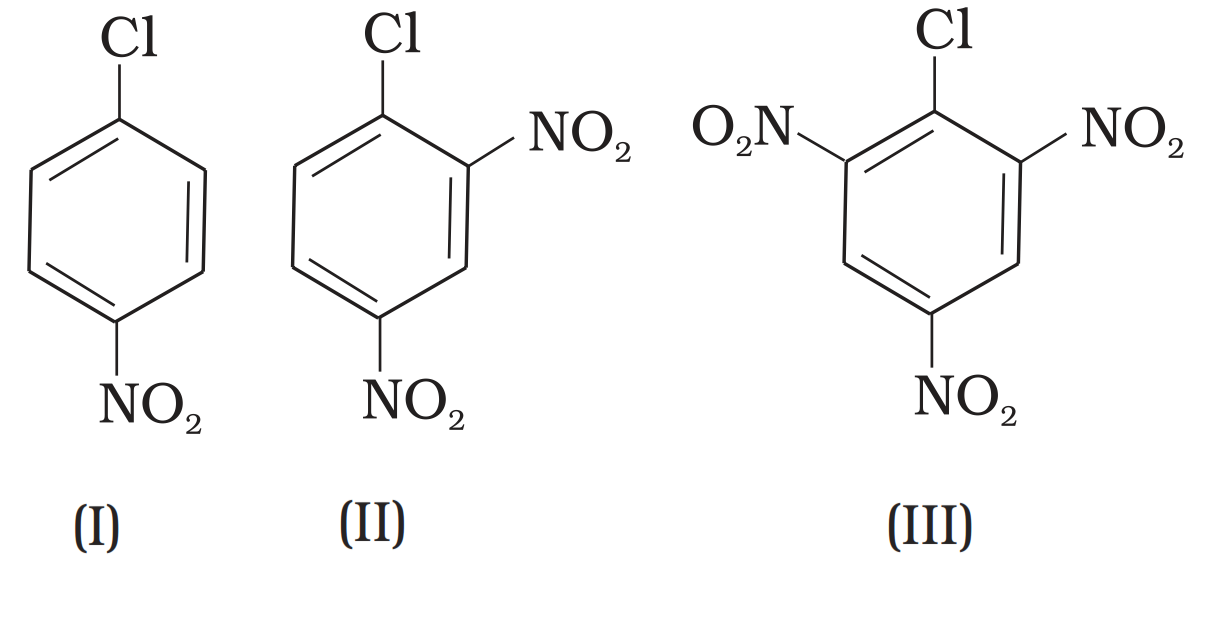
Aryl halides are extremely less reactive towards nucleophilic substitution. Predict and explain the order of reactivity of the following compounds towards nucleophilic substitution:

Use Hund's rule to derive the electronic configuration of Ce3+ ion, and calculate its magnetic moment on the basis of 'spin-only' formula.
Write a note on Strecker reaction.
Define the following terms:
  1. Colligative properties.
  2. Molality (m).
Explain the preparation of ketones from nitriles.
State Henry’s law. Write its one application. What is the effect of temperature on solubility of gases in liquid?