Question
Explain the term Cowper’s glands.

Answer

Cowper’s gland: It secretes a fluid which mixes with the sperms, offers chemical protection, and supports the swimming motion of the sperms. The mucous secretion of Cowper’s glands serves as lubricants and help to contrast the acidity of the semen.

Need a full question paper?

Generate a complete, print-ready paper with questions like this in minutes — across 16+ boards, with answer keys.

Start Generating Free

Similar questions

In an experiment, two sets of apparatus were set up as shown below:
In A there is a concentrated sugar solution inside the thistle funnel and red ink in the water outside the funnel. In B there is a concentrated glucose solution with red ink inside the thistle funnel and water outside the thistle funnel.
In both A and B the level of liquid inside the funnels rises up the tubes. In A the sugar solution turns red and in B, the water turns red.
Study the given observations and answer these questions:
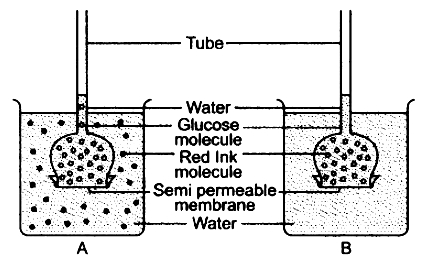
Name the process by which red ink moves in A and B.
Which type of pressure forces the water molecules to move towards thistle funnels and cause a rise in the water level?
Where does this process occur in plants and animals?
What material could be used as a semi-permeable membrane?
Explain the Term :
Industrial melanism
Briefly explain how the rate of transpiration is affected by:
The intensity of light.
What do you mean by transpiration? Explain its importance in plants.
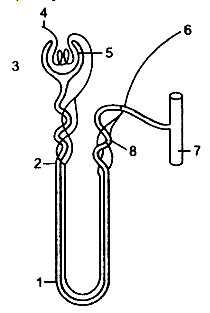
The diagram below represents a mammalian kidney tubule (nephron) and its blood supply. Parts indicated by the guidelines 1 to 8 are as follows:

1. U-shaped loop of Henle
2. Proximal convoluted tubule with blood capillaries
3. Bowman’s capsule
4. Afferent arteriole from the renal artery
5. Glomerulus
6. Venule to the renal vein
7. Collecting tubule
8. Distal convoluted tubule with blood capillaries Study the diagram and answer the following questions in each case:
(i) Where does ultrafiltration take place?
(ii) Which structure contains the lowest concentration of urea?
(iii) Which structure contains the highest concentration of urea?
(iv) Which structure contains the lowest concentration of glucose?
(v) Where is the most water reabsorbed?
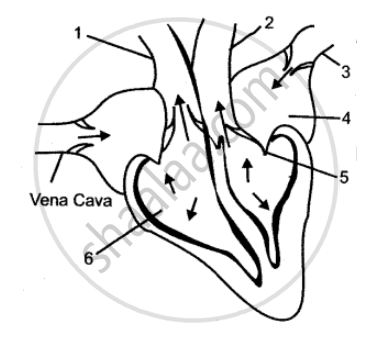
The diagram given below represents the human heart in one phase of its activity. Study the same and then answer the question that follow:
What type of blood flows through the parts marked '1' and '2'?
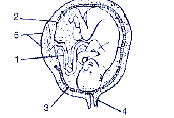
The diagram given alongside is that of a developing human foetus in the womb. Study the same and answer the questions that follows:
Name the parts ‘1’ to ‘5’ indicated by guidelines

Suggest some methods of fertility control in men and women.
Differentiate between the following
Endosmosis and Exosmosis
How do you account for the following difference?
The left ventricle has thicker walls than the right ventricle.