Question
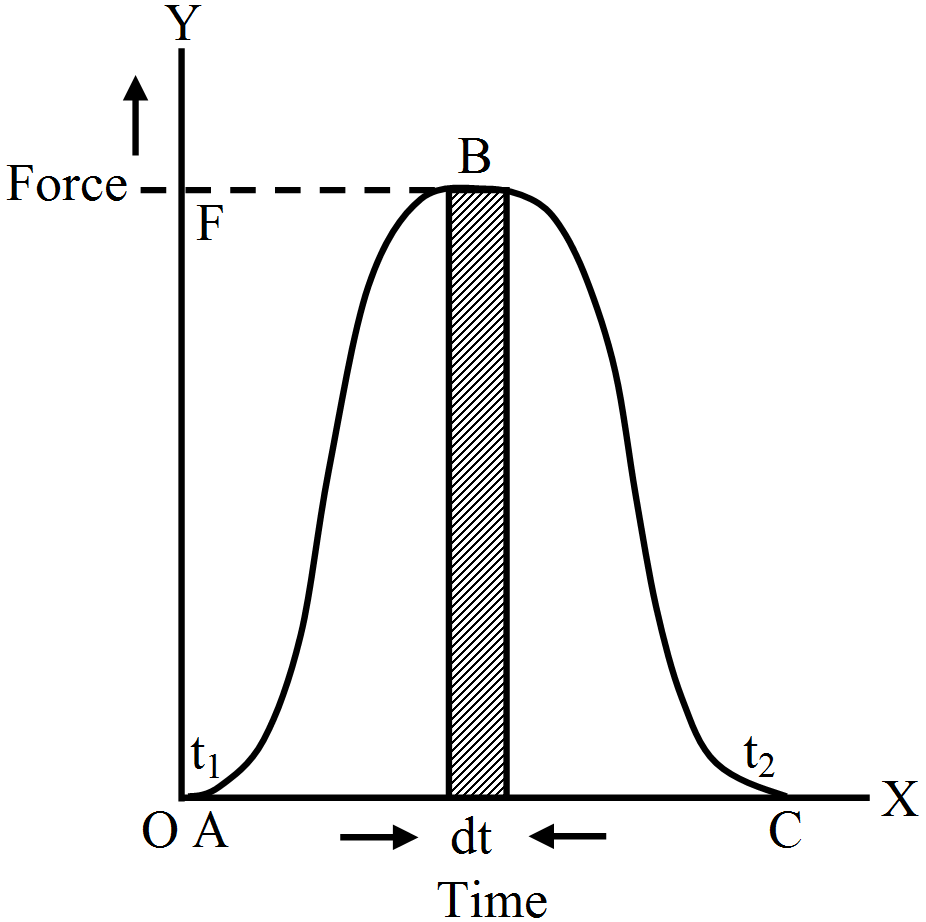
  1. Explain the term impulse. Show that impulse of a variable force is equal to the area enclosed by the force-time curve.
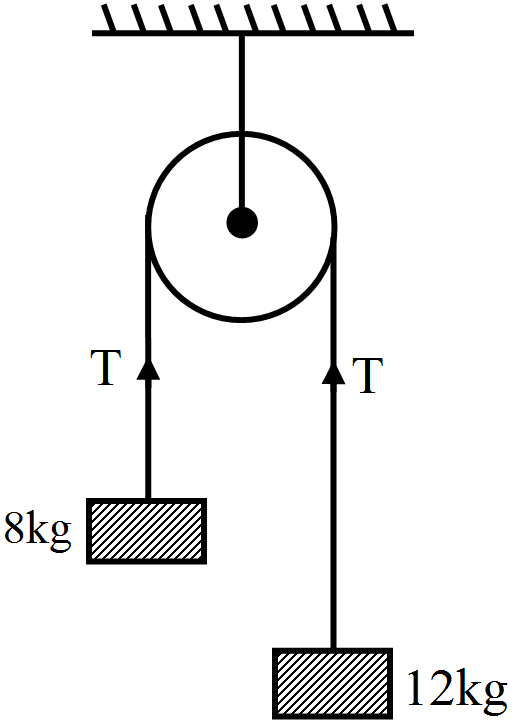
  2. Two masses 8kg and 12kg are connected at the two ends of a light inextensible string that passes over a frictionless pulley. Find the acceleration of the masses and tension in the string, when the masses are released.

Answer

  1. The product of the force and the time interval on which it acts or change in momentum is called impulse.

$\vec{\text{I}}-\vec{\text{F}}_\text{av}\times\text{t}=\text{dp}=\text{F.dt}=$ Area of shaded portion

Net impulse $=\int\limits_{\text{t}_1}^{\text{t}_2}\vec{\text{F}}\times\text{dt}=$ area under graph ABC and time axis.
  1. Consider two masses m1 and m2 are connected to the ends of an inextensible string passing over a smooth frictionless pulley.
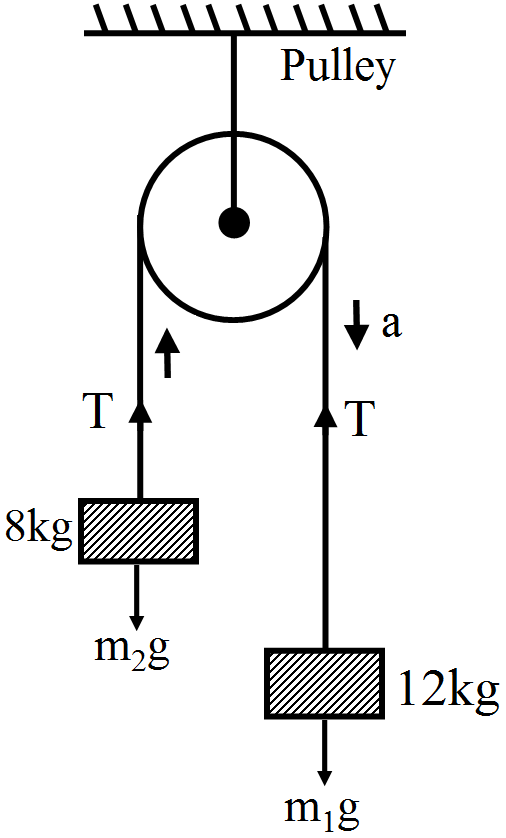
Let T be the tension in the string which is uniform throughout.

The heavier mass m1 moves downward with an acceleration a.

The resultant downward force while considering the heavier mass m, is given by

m1g - T = m1a ...(i)

The resultant upward force while considering the lighter mass m2 is given by

T - m2g = m2a ...(ii)

Adding (i) and (ii), we have

(m1 - m2)g = (m1 + m2)a

$\Rightarrow\ \text{a}=\Big(\frac{\text{m}_1-\text{m}_2}{\text{m}_1+\text{m}_2}\Big)\text{g}\dots(\text{iii})$

Putting the value of a in (i) and simplifying we get

$\text{T}=\frac{2\text{m}_1\text{m}_2}{\text{m}_1+\text{m}_2}\text{g}\dots(\text{iv})$

Substituting the given values, we have

$\Rightarrow\ \text{a}=\Big(\frac{12-8}{12+8}\Big)\times9.8=1.96\text{ms}^{-2}$

$\text{T}=\frac{2\times12\times8\times9.8}{12+8}=\frac{1881.6}{20}$

$=64.08\text{N}$
Need a full question paper?

Generate a complete, print-ready paper with questions like this in minutes — across 16+ boards, with answer keys.

Start Generating Free

Similar questions

Find the angular velocity of a body rotating with an acceleration of 2 rev/s2 as it completes the 5th revolution after the start.
Why does a metal bar appear hotter than a wooden bar at the same temperature? Equivalently it also appears cooler than wooden bar if they are both colder than room temperature.
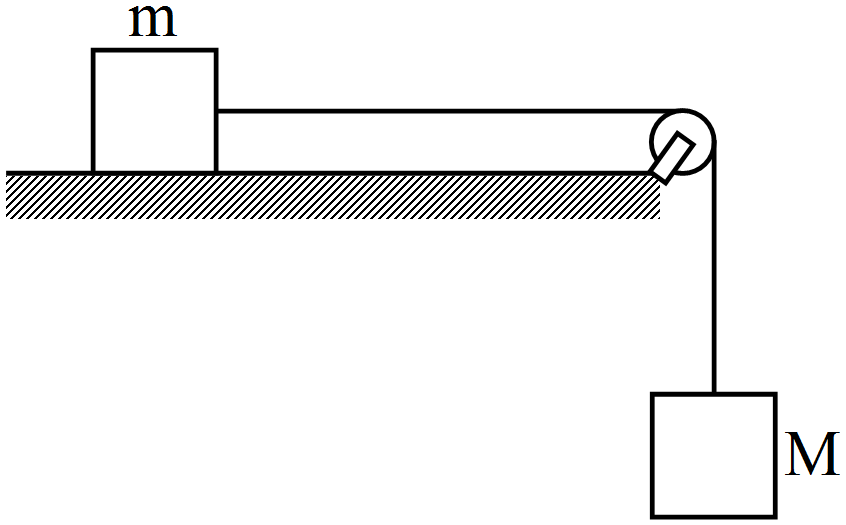
Figure shows two blocks of masses m and M connected by a string passing over a pulley. The horizontal table over which the mass m slides is smooth. The pulley has a radius r and moment of inertia I about its axis and it can freely rotate about this axis. Find the acceleration of the mass M assuming that the string does not slip on the pulley.

A block placed on a rough horizontal surface is pulled by a horizontal force F. Let f be the force applied by the rough surface on the block. Plot a graph of f versus F.
To maintain a rotor at a uniform angular speed of 200rad s-1, an engine needs to transmit a torque of 180Nm. What is the power required by the engine?
(Note: uniform angular velocity in the absence of friction implies zero torque. In practice, applied torque is needed to counter frictional torque). Assume that the engine is 100% efficient.
On a certain day, speed of sound in air is 350m/s. What is the frequency of fundamental note in a closed pipe of length 0.5m? Also find the frequency of second overtone.
In which of the following examples of motion can the body be considered approximately a point object :
(a) a railway carriage moving without jerks between two stations.
(b) a monkey sitting on top of a man cycling smoothly on a circular track.
(c) a spinning cricket ball that turns sharply on hitting the ground.
(d) a tumbling beaker that has slipped off the edge of a table.
The potential energy of a particle of mass 1kg in motion along the x-axis is given by $\text{U}=4(1-\cos2\text{x})$ Here x is in metres. Find the period of small oscillations.
How does the velocity-time graph for uniform motion give a geometrical way of calculating the displacement covered during a given time t?