Question
Explain the term ‘steady state’.

Answer

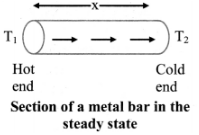
When one end of a metal rod is heated, the heat flows by conduction from hot end to the cold end.

Image

  1. As a result, the temperature of every section of the rod starts increasing.
  2. Under this condition, the rod is said to be in a variable temperature state.
  3. After some time, the temperature at each section of the rod becomes steady i.e., does not change.
  4. Temperature of each cross-section of the rod now becomes constant though not the same. This is called steady state condition.

Need a full question paper?

Generate a complete, print-ready paper with questions like this in minutes — across 16+ boards, with answer keys.
Start Generating Free

Similar questions

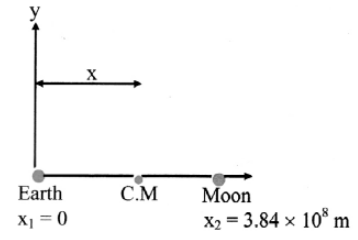
The mass of moon is $0.0 123$ times the mass of the earth and separation between them is $3.84 \times 10^8 m.$ Determine the location of $C.M$ as measured from the centre of the earth.
Image
A constantan wire of length $50 \ cm$ and $0.4 \ mm$ diameter is used in making a resistor. If the resistivity of constantan is $5 \times 10^{-7} m$, calculate the value of the resistor.
A charge of $5.0 C$ is kept at the centre of a sphere of radius $1 m.$ What is the flux passing through the sphere? How will this value change if the radius of the sphere is doubled?
distinguish between:
Contact and non-contact forces
Can you now tell why the balloon bursts sometimes when you try to fill air in it?
Four charges of $+6 \times 10^{-8}\ C$ each are placed at the corners of a square whose sides are $3\ cm$ each. Calculate the resultant force on each charge and show in direction on a diagram drawn to scale.
Why does amplitude modulation give noisy reception?
A radar has a power of $10 \ kW$ and is operating at a frequency of $20 \ GHz.$ It is located on the top of a hill of height $500 m.$ Calculate the maximum distance upto which it can detect object located on the surface of the Earth.
$($Radius of Earth $= 6.4 \times 10^6 m)$
What are ultraviolet rays? Give two uses.
An aeroplane $A,$ is travelling in a straight line with a velocity of $300 \ km/hr$ with respect to Earth. Another aeroplane $B,$ is travelling in the opposite direction with a velocity of $350 \ km/hr$ with respect to Earth. What is the relative velocity of $A$ with respect to $B$? What should be the velocity of a third aeroplane $C$ moving parallel to $A,$ relative to the Earth if it has a relative velocity of $100 \ km/hr$ with respect to $A$?