Question
Explain the term uniform circular motion.

Answer

  1. The motion of a body along the circumference of a circle with constant speed is called uniform circular motion.
  2. The magnitude of velocity remains constant and its direction is tangential to its circular path.
  3. The acceleration is of constant magnitude and it is perpendicular to the tangential velocity. It is always directed towards the centre of the circular path. This acceleration is called centripetal acceleration.
  4. The centripetal force provides the necessary centripetal acceleration.
  5. Examples of U.C.M:
    • Motion of the earth around the sun.
    • Motion of the moon around the earth.
    • Revolution of electron around the nucleus of atom.

Need a full question paper?

Generate a complete, print-ready paper with questions like this in minutes — across 16+ boards, with answer keys.
Start Generating Free

Similar questions

Calculate the period of revolution of Jupiter around the Sun. The ratio of the radius of Jupiter’s orbit to that of the Earth’s orbit is $5.$ $($Period of revolution of the Earth is $1$ year$.)$
Show that the path of a projectile is a parabola.
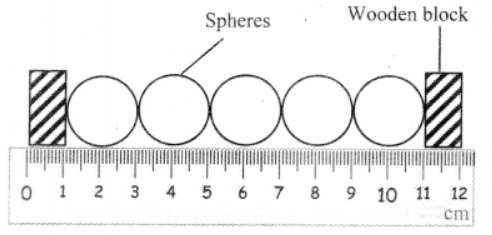
A factory owner kept five identical spheres between two wooden blocks on a ruler as shown in figure. He called all his workers and told them to take reading, to check their efficiency and knowledge.
Image
$i.$ What is the area of central sphere?
$ii.$ What is the absolute error in reading of diameter of second sphere?
Discuss qualitative idea for the gravitational force of attraction between a hollow spherical shell or solid sphere of uniform density and a point mass situated outside the shell / sphere.
What is a carrier wave?
If the height of a $TV$ transmitting antenna is $128 m,$ how much square area can be covered by the transmitted signal if the receiving antenna is at the ground level? $($Radius of the Earth $= 6400 \ km)$
Colour code of resistor is Yellow-Violet- Orange-Gold. Find its value.
State the expression for apparent frequency when source is stationary and listener is
$1)$ moving towards the source
$2)$ moving away from the source
What is the strain in a cable of original length 50m whose length increases by 2.5cm when a load is lifted?
Calculate the escape velocity of a body from the surface of the Earth.
$($Average density of Earth $= 5.5 \times 10^3 \ kg/m^3, G = 6.67 \times 10^{-11} \ N m^2/kg^2,$ radius of Earth $R = 6.4 \times 10^6 m)$