Question
Explain the terms ultrafiltration and selective absorption

Answer

Ultrafiltration-
Ultrafiltration involves filtration of the blood which takes place in the glomerulus. The blood containing urea from the afferent arteriole enters the glomerulus under high pressure. The high pressure is created because the efferent arteriole is narrower than the afferent arteriole. The high pressure causes the liquid part of the blood to filter out from the glomerulus into the renal tubule. This filtrate is known as 'glomerular filtrate'. Glomerular filtrate consists of water, urea, salts, glucose and other plasma solutes. Blood corpuscles, proteins and other large molecules remain behind in the glomerulus. Therefore the blood which is carried away by the efferent arteriole is relatively thick.
Selective absorption -The Glomerular filtrate entering the renal tubule contains a lot of usable materials such as glucose and sodium. As this filtrate passes down the renal tubule, a lot of water along with these usable materials is reabsorbed. Such reabsorption is called 'selective absorption'. The reabsorption occurs only to the extent that the normal concentration of the blood is undisturbed.

Need a full question paper?

Generate a complete, print-ready paper with questions like this in minutes — across 16+ boards, with answer keys.

Start Generating Free

Similar questions

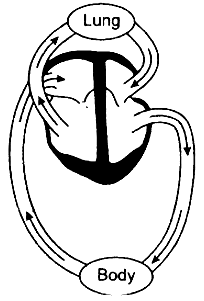
The diagram represents the ‘closed system’ or ‘double circulation’ of blood in mammals.

Justify the above statement.
State two structural and two functional differences between the arteries and veins.
State the changes in the composition of blood as it passes through the following organs:
(a) Lungs (b) Gut (c) Liver (d) Kidneys.
How is root hair adapted for the absorption of water from the soil?
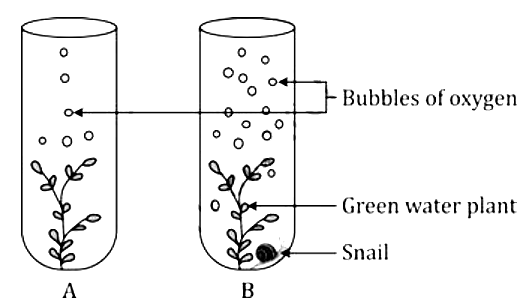
The diagram below shows two test-tubes A and B. Test-tube A contains a green water plant. Test-tube B contains both a green water plant and a snail. Both test-tubes are kept in sunlight. Answer the questions that follow:

(a) Name the physiological process that releases the bubbles of oxygen.
(b) Explain the physiological process as mentioned above in (a).
(c) What is the purpose of keeping a snail in test-tube B?
(d) Why does test-tube B have more bubbles of oxygen?
(e) Give an example of a water plant that can be used in the above experiment.
(f) Write the overall chemical equation for the above process.
Draw labeled diagram of different steps of mitosis.
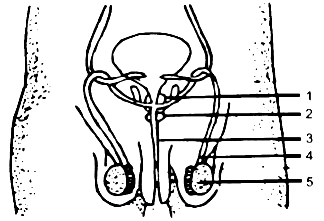
Given below is the outline of the male reproductive system.

(i) Name the parts labeled 1 to 5.
(ii) State the functions of the parts labeled 1 and 4.
(iii) Name the cells of part 5 that produce testosterone.
(iv) Why is structure 5 present outside the body in the scrotal sacs?
(v) What is semen?
(i) Fill in the blanks in the following equations of two chemical reactions:
(a) $\ce{---+12H2O->[Light energy]C6H12O6 + --- + ----}$
(b) $\ce{--- 6O2->[Chlorophyll] 6 --- +6 ---- + Energy}$
(ii) Name the two processes represented by the above two reactions.
(iii) State any two differences in these processes other than those already indicated in the reactions.
(iv) Which one of these two reactions is the supporter of all life on earth?
Why Neanderthal man and modern man belong to two distinct species?
A candidate in order to study the process of osmosis has taken 3 potato cubes and put them in 3 different beakers containing 3 different solutions. After 24 hours, in the first beaker the potato cube increased in size, in the second beaker the potato cube decreased in size and in the third beaker there was no change in the size of the potato cube. The following diagram shows the result of the same experiment:
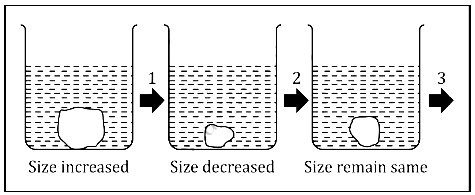
(i) Give the technical terms of the solutions used in beakers, 1, 2 and 3.
(ii) In beaker 3, the size of the potato cube remains the same. Explain the reason in brief.
(iii) Write the specific feature of the cell sap of root hairs which helps in absorption of water.
(iv) What is osmosis?
(v) How does a cell wall and a cell membrane differ in their permeability?
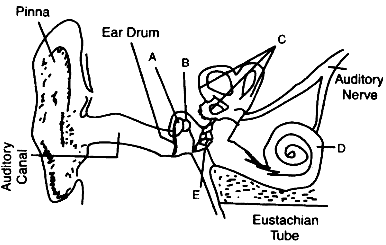
Given below is the diagram of the human ear. Study the diagram and then answer the questions that follow:
(i) What role does the eardrum play in hearing?
(ii) What common term is given to the parts labeled A, B, and E?
(iii) Would there be any difference if these three parts mentioned in (ii) above were replaced by one by one? Why?
(iv) Give the biological term for the parts labeled C and D.
(v) Name the fluid which fills the parts mentioned in (iv) above.
(vi) State the functions of the ear.
With the help of an experiment, prove that roots are more positively hydrotropic than geotropic.