Question
Explain the terms with suitable examples: (1) Gel, (2) Aerosol, and (3) Hydrosol.

Answer

(1) Gel : A colloidal dispersion of liquid in solid.
(2) Aerosol : A colloidal dispersion of solid (or liquid) in gas..
(3) Hydrosol : A colloidal dispersion of solid in water.

Need a full question paper?

Generate a complete, print-ready paper with questions like this in minutes — across 16+ boards, with answer keys.
Start Generating Free

Similar questions

What is mutarotation?
Note: In the following questions a statement of assertion followed by a statement of reason is given. Choose the correct answer out of the following choices.
  1. Both assertion and reason are true and the reason is the correct explanation of assertion.
  2. Both assertion and reason are true and the reason is not the correct explanation of assertion.
  3. Assertion is true but the reason is false.
  4. Both assertion and reason are false.
  5. Assertion is false but reason is true.
Assertion: For measuring resistance of an ionic solution an AC source is used.
Reason: Concentration of ionic solution will change if DC source is used.
Write the important structural and functional differences between DNA and RNA.
Calculate the freezing point of a solution containing $60g$ of glucose $($Molar mass $= 180g mol^{-1})$ in $250g$ of water.
$(K_f $ of water $= 1.86K \ kg mol^{-1})$
A reaction is second order with respect to a reactant. How is the rate of reaction affected if the concentration of the reactant is :
(i) doubled (ii) reduced to half ?
Draw figure to show the splitting of d orbitals in an octahedral crystal field. orbitals in an octahedral crystal field.
Describe the following :
Cannizzaro reaction
Phenol is more easily nitrated than benzene.
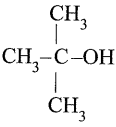
Write common name and IUPAC name of following alcohol compound.
Image
A galvanic cell has electrical potential of 1.1V. If an opposing potential of 1.1V is applied to this cell, what will happen to the cell reaction and current flowing through the cell?