Maharashtra BoardEnglish MediumSTD 12 SciencePhysicsQuestion Bank [ 2022 ]4 Marks
Question
Explain the thermodynamics of the isobaric process.
✓
Answer
i. A thermodynamic process that is carried out at constant pressure i.e., $\Delta p =0$ is called the isobaric process.
ii. For an isobaric process, none of the quantities $\Delta U, Q$, and $W$ is zero.
iii. The temperature of the system changes, i.e., $\Delta T \neq 0$.
iv. The energy exchanged is used to do work as well as to change internal energy causing an increase in temperature. Thus, $Q =\Delta U + W$.
As work is done volume changes during the process.
Heat exchanged in case of an isobaric process:
a. Consider an ideal gas undergoing volume expansion at constant pressure.
b. If $V_i$ and $T_i$ are its volume and temperature in the initial state of a system and $V_f$ and $T_f$ are its final volume and temperature respectively, the work done in the expansion is given by,
$W = pdV = p(V_f – V_i) = nR(T_f – T_i) ….(1)$
c. Also, the change in the internal energy of a system is given by, $\triangle U = nC_V\triangle T = nC_V(T_f – T_i) ….(2)$
Where, $C_V$ is the specific heat at constant volume, and \triangle $T = (T_f – T_i)$ is the change in its temperature during the isobaric process.
d. According to the first law of thermodynamics, the heat exchanged is given by, $Q = \triangle U + W$
Using equations (1) and (2) we get,
$Q = nC_V(T_f – T_i) + nR(T_f – T_i)$
$\therefore Q = (nC_V + nR) (T_f – T_i)$
$\therefore Q = nC_p(T_f – T_i) .............(\because C_p = C_V + R)$
Where,$ C_p$ is the specific heat at constant pressure.
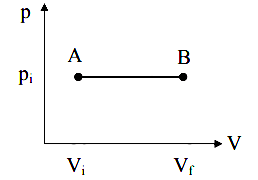
The p-V diagram for an isobaric process is called isobar. It is shown in the figure below.
Need a full question paper?
Generate a complete, print-ready paper with questions like this in minutes — across 16+ boards, with answer keys.