Question
Explain the unit of energy $e{V}$ (electron volt) and define 1 eV .

Answer

→$e V$ is a smallest unit of energy. It is commonly used in atomic and nuclear physics.
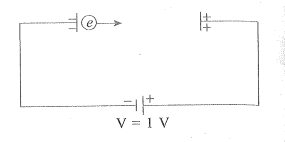
→The energy gained by accelerating an electron with a potential difference of 1 volt is called 1 eV Image
→Energy gained by electron,
$K =q V \quad(\because w=\Delta K = V q)$
$\therefore \quad K =e V \quad(\because q=e=$ charge of electron $)$
$K =1.6 \times 10^{-19} \times 1$
$\therefore \quad K =1.6 \times 10^{-19} J$
$\therefore \quad K =1 eV$
$\therefore 1 eV =1.6 \times 10^{-19} J$

Need a full question paper?

Generate a complete, print-ready paper with questions like this in minutes — across 16+ boards, with answer keys.
Start Generating Free

Similar questions

Compare the following:
i. Wavelengths of the incident solar radiation absorbed by the earth's surface and the radiation re-radiated by the earth.
ii. Tanning effect produced on the skin by UV incident directly on the skin and that coming through glass window.
What is electric current ? Explain about it.
The torque on a current loop is zero if the angle between the positive normal and the magnetic field is either $\theta=0^\circ$ or $\theta=180^\circ$ In which of the two orientations, the equilibrium is stable?
A light bulb is rated at $100 W$ for a $220 V$ supply. Find (a) the resistance of the bulb; (b) the peak voltage of the source; and (c) the rms current through the bulb.
A block of massip, sliding on a smooth horizontal surface with a velocity $\vec{\text{v}}$ meets a long horizontal spring fixed at one end and having spring constant k as shown in figure. Find the maximum compression of tin spring. Will the velocity of the block be the same $\vec{\text{v}}$ when it comes back to the original position shown?
Consider Experiment 6.2. (a) What would you do to obtain a large deflection of the galvanometer? (b) How would you demonstrate the presence of an induced current in the absence of a galvanometer?
Two electric trains run at the same speed of $72\ km/h$ along the same track and in the same direction with a separation of $2.4\ km$ between them. The two trains simultaneously sound brief whistles. A person is situated at a perpendicular distance of $500m$ from the track and is equidistant from the two trains at the instant of the whistling. If both the whistles were at $500Hz$ and the speed of sound in air is $340m/s,$ find the frequencies heard by the person.
An electron gun emits $2.0 \times 10^{16}$ electrons per second. What electric current does this correspond to?
What are the (a) momentum, (b) de-Broglie wavelength of an electron with kinetic energy of 120 eV. ? Find.
Which physical quantities are conserved in natural and artificial radioactivity?