Question
Explain the uses of Polaroid.

Answer

Uses of Polaroid :
1. To remove glare : Polaroid is used to reduce the glare caused by reflection of light from extremely white or bright surfaces or wet roads or the scorching sun. Glare consists of partially polarized light. If polaroid glasses are worn on the eyes, it will cut off the horizontal vibrations of partially polarized light. Hence the glare will be eliminated.
2. To prevent accidents : When the light emitted from the headlights of motor cars and trucks falls on the hood of a motor car or truck coming from the other side, the reflected light reaches the eyes and causes glare. This not only causes pain to the eyes, but there is also a possibility of an accident. To overcome this, headlight cover glass and windscreen are made of polaroid.
3. In polaroid camera or photography : A polaroid is placed in front of the lens of the polaroid camera so that the polarized light coming in its background is blocked by the polaroid.
4. To determine the concentration of sugar: The concentration of sugar is determined by polari meter. Polaroids are used to produce and analyze plane polarized light in a polari meter.
5. In the study of optical properties of metals.
6. To study the effect of stresses.
Need a full question paper?

Generate a complete, print-ready paper with questions like this in minutes — across 16+ boards, with answer keys.

Start Generating Free

Similar questions

Consider the Atwood machine of the previous problem. The larger mass is stopped for a moment $2.0s$ after the system is set into motion. Find the time elapsed before the string is tight again.
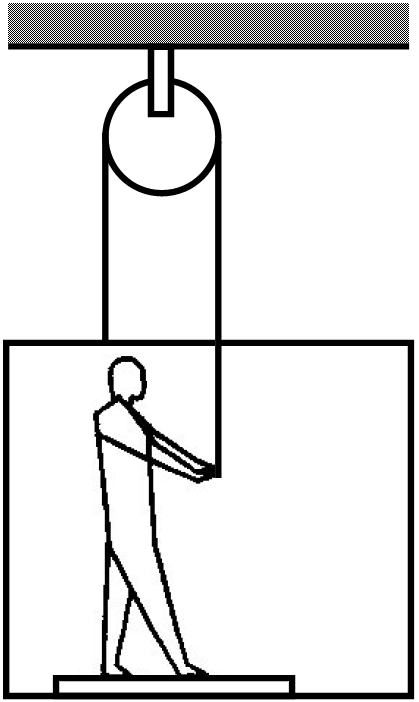
Figure shows a man of mass $60\ kg$ standing on a light weighing machine kept in a box of mass $30\ kg$. The box is hanging from a pulley fixed to the ceiling through a light rope, the other end of which is held by the man himself. If the man manages to keep the box at rest, what is the weight shown by the machine? What force should he exert on the rope to get his correct weight on the machine?
A charge of $8 \ mC$ is located at the origin. Calculate the work done in taking a small charge of $–2 \times 10^{–9} C$ from a point $P (0, 0, 3 \ cm)$ to a point $Q (0, 4 \ cm, 0),$ via a point $R (0, 6 \ cm, 9 \ cm)$.
A $4µF$ capacitor is charged by a $200V$ supply. It is then disconnected from the supply, and is connected to another uncharged $2µF$ capacitor. How much electrostatic energy of the first capacitor is lost in the form of heat and electromagnetic radiation?
$i$. What do you understand by the sharpness of resonance in a series $L-C-R$ circuit? Derive an expression for $Q$ factor of the circuit.
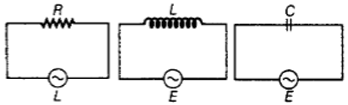
$ii$. Three electrical circuits having $AC$ sources of variable frequency are shown in the figures.
Initially, the current flowing in each of these is same. If the frequency of the applied $AC$ source is increased, how will the current flowing in these circuits be affected? Give the reason for your answer.
Image ​​​​​​​
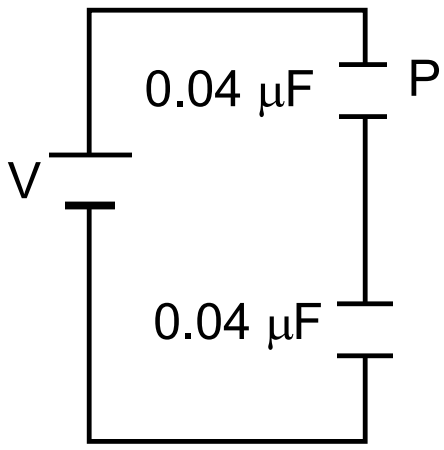
The particle $P$ shown in figure has a mass of $10mg$ and a charge of $-0.01\mu\text{C}.$ Each plate has a surface area $100\ cm^2 $ on one side. What potential difference $V$ should be applied to the combination to hold the particle $P$ in equilibrium?
A coil of 0.01 henry inductance and 1ohm resistance is connected to 200volt, 50Hz ac supply. Find the impedance of the circuit and time lag between max. alternating voltage and current.
A pin of length 2.0cm lies along the principal axis of a converging lens, the centre being at a distance of 11cm from the lens. The focal length of the lens is 6cm. Find the size of the image.
Find the speed of an electron with kinetic energy:
  1.  1eV
  2. 10keV
  3. 10MeV
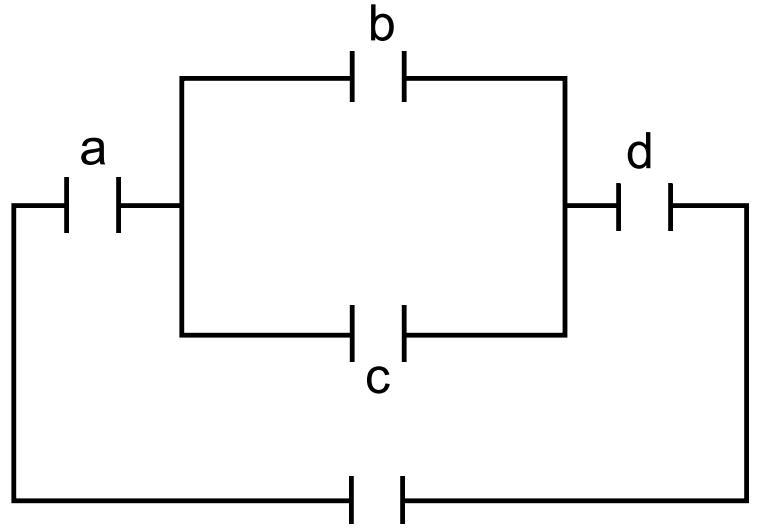
Each capacitor in figure has a capacitance of $10\mu\text{F}.$ The emf of the battery is 100V. Find the energy stored in each of the four capacitors.