Question
Explain the variation in ionization enthalpies of transition element in 3d series.

Answer

→ Due to an increase in nuclear charge which accompanies the filling of the inner d orbitals, there is an increase in ionization enthalpy along each series of the transition elements from left to right.
→ The irregular trend in the first ionization enthalpy of the 3d metals, though of little chemical significance, can be accounted for by considering that the removal of one electron alters the relative energies of 4s and 3d orbitals.
→ So the unipositive ions have dn configurations with no 4s electrons. There is thus, a reorganization energy accompanying ionization with some gains in exchange energy as the number of electrons increases and from the transference of s electrons into d orbitals.
→ There is the generally expected increasing trend in the values as the effective nuclear charge increases. However, the value of Cr is lower because of the absence of any change in the d configuration and the value for Zn higher because it represent an ionization from the 4s level.
→ The lowest common oxidation state of these metals is +2. To form the M2+ ions fron the gaseous atoms, the sum of the first and second ionization energies is required in addition to the enthalpy of atomization for each element.
→ The dominant term is the second ionization enthalpy which shows unusually high values for Cr and Cu where the d5 and d10 configurations of the M+ ions are disrupted, with considerable loss of exchange energy. The value for Zn is correspondingly low as the ionization consists of the removal of an electron which allows the production of the stable d10 configuration.
→ The trend in the third ionization enthalpies is not complicated by the 4s orbital factor and shows the greater difficulty of removing and electron from the d5 (Mn2+) and d10 (Zn2+) ions superimposed upon the general increasing trend. In general, the third ionization enthalpies are quite high and there is a marked break between the values for Mn2+ and Fe2+.
→ Also, the high values for copper, nickel and zinc indicate why it is difficult to obtain oxidation state greater than two for these elements.
Need a full question paper?

Generate a complete, print-ready paper with questions like this in minutes — across 16+ boards, with answer keys.

Start Generating Free

Similar questions

Write a mote on molar conductivity $\left(\wedge_{\text {m }}\right)$ of solution and write down it's formula.
What is azeotropes? Explain it's Types.
  1. State one use each of DDT and iodoform.
  2. Which compound in the following couples will react faster in SN2 displacement and why?
  1. 1-Bromopentane or 2-bromopentane.
  2. 1-Bromo-2-methylbutane or 2-bromo-2-methylbutane.
Account for any two of the following:
  1. Amines are basic substances while amides are neutral.
  2. Nitro compounds have higher boiling points than the hydrocarbons having almost the same molecular mass.
  3. Aromatic amines are weaker bases than aliphatic amines.
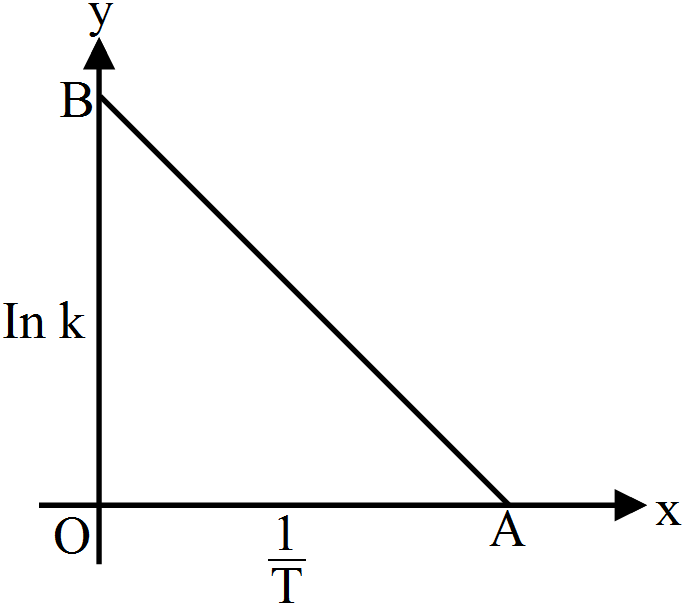
A graph between ln k and $\frac{1}{\text{t}}$ for a reaction is given. Here k is rate constant and T is temperature in Kelvin.

If OA = a and OB = b, answer the following:

  1. What is the activation energy (Ea) of the reaction?
  2. What is the frequency factor (A) for the reaction?

The rate constant for the decomposition of ethyl iodide
C2H5l(g) → C2H4(g)+Hl(g)
at 600K is 1.60 × 10⁻⁵ s-1 . Its energy of activation is 209kJ/mol. Calculate the rate constant of the reaction at 700K.
The halides of transition elements become more covalent with increasing oxidation state of the metal.
A solution prepared by dissolving 8.95mg of a gene fragment in 35.0mL. of water has an osmotic pressure of 0.335 torr at 25°C. Assuming that the gene fragment is a non-electrolyte, calculate its molar mass.
To coat a layer of 0.004 mm thick Ag on the surface of copper metal whose area is $60 cm^2$, it will be necessary to flow a current of 5.0 ampere in $A g N O _3$ solution, for how much time should it flow? (Density of silver $=10.5 g cm ^{-3}$ and atomic mass of $Ag =108$ )
In a reaction if the concentration of reactant A is tripled, the rate of reaction becomes twenty seven times. What is the order of the reaction?