Question
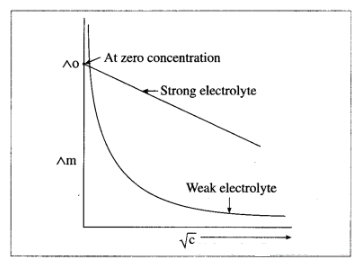
Explain the variation of molar conductivity with concentration for strong and weak electrolytes.
###
How is the molar conductivity of strong electrolytes at zero concentration determined by graphical method? Why is this method not useful for weak electrolytes?
Need a full question paper?

Generate a complete, print-ready paper with questions like this in minutes — across 16+ boards, with answer keys.

Start Generating Free

Similar questions

Explain with the help of balanced chemical equation, why the solution of $Ce(IV)$ is prepared in acidic medium.
For the reaction $A+B \rightarrow P.$
If $[B]$ is doubled at constant $[A],$ the rate of reaction doubled. If $[A]$ is triple and $[B]$ is doubled, the rate of reaction increases by a factor of $6.$ Calculate the rate law equation.
While considering boiling point elevation and freezing point depression a solution concentration is expressed in molality and not in molarity. Why?
Write chemical composition of haematite. Write the names and electronic configurations of first two elements of group $17.$
What is effective atomic number? Calculate effective atomic number of copper $(Z=29)$ in $[Cu(NH_3)_4]^{2+}.$
Observe the following and answer the questions given below.
$CH _2= CH -\ddot{ X }: \longleftrightarrow \stackrel{\ominus}{ CH _2- CH =\stackrel{\oplus}{ X }:}$
$a.$ Name the type of halogen derivative
$b.$ Comment on the bond length of $C-X$ bond in it
$c.$ Can react by $SN1$ mechanism? Justify your answer.
What are the properties of the interstitial compounds of transition metals?
The vapour pressures of two liquids $A$ and $B$ are $400 mm Hg$ and $600 mm Hg$ respectively at 47 ${ }^{\circ} C$. A solution is prepared by dissolving $10 g$ of $A$ of molar mass $60 g mol ^{-1}$ in $80 g$ of $B$ of molar mass $40 g mol ^{-1}$. Find the vapour pressure of the solution.
Write a note on Gabriel phthalimide synthesis.
What is the action of dioxygen on:
(a) Calcium (b) Iron (c) Carbon disulphide?