Question
Explain the various methods of determining the order of a reaction.

Answer

self

Need a full question paper?

Generate a complete, print-ready paper with questions like this in minutes — across 16+ boards, with answer keys.

Start Generating Free

Similar questions

Match the items of Column $I$ and Column $II$ on the basis of data given below$:$
$\text{E}^{\ominus}_{\text{F}_2/\text{F}^-}=2.87\text{V},\text{ E}^{\ominus}_{\text{Li}^+/\text{Li}}=-3.5\text{V},\text {E}^{\ominus}_{\text{Au}^{3+}/\text{Au}}=1.4\text{V},\text{ E}^{\ominus}_{ \text{Br}_2/\text{Br}^-}=1.09\text{V}$
 
Column $I$
 
Column $II$
$i.$ $F_2$ $a.$
Metal is the strongest reducing agent.
$ii.$ $Li$ $b.$
Metal ion which is the weakest oxidising agent.
$iii.$ $Au^{3+}$ $c.$
Non metal which is the best oxidising agent.
$iv.$ $Br^-$ $d.$
Unreactive metal.
$v.$ $Au$ $e.$
Anion that can be oxidised by $Au^{3+}$
$vi.$ $Li^+$ $f.$
Anion which is the weakest reducing agent.
$vii.$ $F^-$ $g.$
Metal ion which is an oxidising agent.
Explain the terms primary and secondary structure of proteins. What is the difference between α-helix and β-pleated sheet structure of proteins?
How much electricity in terms of Faraday is required to produce:
(i) 20.0 g of Ca from molten $CaCl_{2}$, (ii) 40.0 g of Al from molten $Al_{2}O_{3}$.
Describe the physical properties of amines.
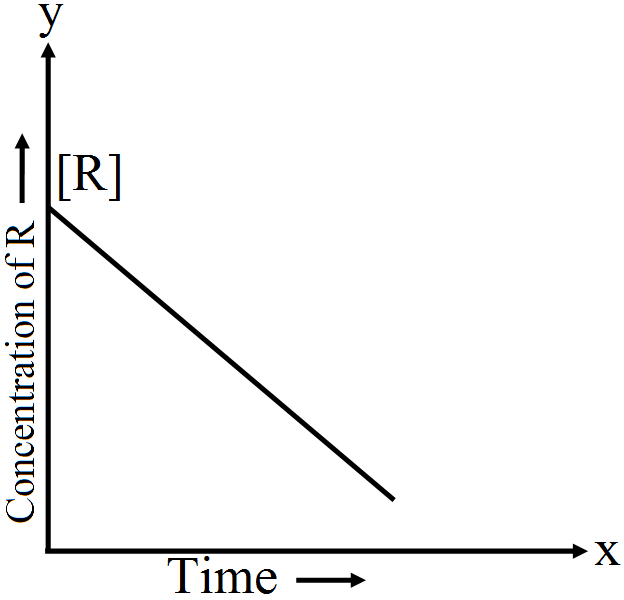
In the reaction
$Q + R \rightarrow$ Products
The time taken for $99\%$ reaction of $Q$ is twice the time taken for $90\%$ reaction of $R.$ The concentration of $R$ varies with time as shown in the figure given alongside.

What is the overall order of the reaction? Give the units of the rate constant for the same. Write the rate expression for the above reaction.
Prove that the relative depression of vapour pressure is equal to the mole fraction of solute.
Explain relationship between $E _{\text {cell }}^{\circ}$ and equilibrium constant with the help of Nernst equation.
Give the structures of $A, B$ and $C$ in the following reactions :
(i) $CH _3 CH _2 I \xrightarrow{ NaCN }$$A \frac{ OH ^{-}}{\text {partial hydrolysis }} \rightarrow B$$\xrightarrow{ NaOH + Br _2} C$
(ii) $C _6 H _5 Cl \xrightarrow{ CuCN } A \xrightarrow{ H _2 O / H ^{+}} B \xrightarrow{ NH _3} C$
(iii) $CH _3 CH _2 Br \xrightarrow{ KCN } A \xrightarrow{ LiAlH _4} B \frac{ HNO _2}{0^{\circ} C } \rightarrow C$
(iv) $C _6 H _5 NO _2 \xrightarrow{ Fe / HCl } A \xrightarrow{ NaNO _2+ HCl } B$ $\xrightarrow{ H _2 O / H ^{+}} C$
(v) $CH _3 COOH \frac{ NH _3}{ Heat } \rightarrow$ A $\xrightarrow{NaOBr} B$$\xrightarrow{ NaNO _2 / HCl } C$
(vi) $C _6 H _5 NO _2 \xrightarrow{ Fe / HCl }A \frac{ HNO _2}{273 K} \rightarrow$$B \xrightarrow{ C _6 H _5 OH } C$
The elements of $3d$ transition series are given as:
$\ce{Sc Ti V Cr Mn Fe Co Ni Cu Zn.}$
Answer the following:
  1. Write the element which shows maximum number of oxidation states. Give reason.
  2. Which element has the highest m.p?
  3. Which element shows only $+ 3$ oxidation state?
  4. Which element is a strong oxidizing agent in $+ 3$ oxidation state and why?
Explain the various methods of preparation of $CHCl _3$ and its chemical properties.