Question
Explain the various types of interactions between species.

Answer

In nature, living organisms such as animals, plants and microbes, cannot live in isolation and therefore, interact in various ways to form a biological community.
The interactions between populations of species in a community are broadly divided into two categories:
Positive Interactions:
Symbiosis or Mutualism: When two species live together in a close association that is helpful to both species, the relationship is known as symbiosis. The oxpecker bird and the rhinoceros exhibit this relationship. The oxpecker receives protection and obtains food from the ticks and other pests infesting the rhino’s skin.

Commensalism: Some organisms live together so that one organism benefits by the relationship while the other organism is neither helped nor harmed. This type of relationship is known as commensalism. An example of this association is the relationship between the shark and the small remora fish.

Negative Interactions: Certain interactions between different species give rise to negative effect on either or both species. Parasitism and predation are interaction where one species gains and the other suffers. While in the interaction called competition both species are harmed.
Parasitism: This is a relationship in which one organism, the parasite spends much or all of its life living in or another organism, the host. The parasite is dependent upon the host for food. The parasite benefits from the relationship and the host is always harmed. Parasites may bring about the death of their host, but most often only weaken their host. Human parasites may be external (ectoparasites) such as body lice, ticks, mites and leeches, or internal (endoparasites) such as tapeworms, some types of roundworms, malarial parasite, microfilaria and guineaworm.
Predation: This is commonly associated with the idea of strong attacking the weak such as the tiger pouncing upon the deer, the hawk upon the sparrow, and the frog upon the insects and so on. A species such as the frog may be both a prey and a predator. The relationship between a snake and a rat is more than that between a prey and a predator as the snake also seeks shelter in the rat holes.
Competition: The amount of food, light, space, minerals and water that are available in a particular habitat is limited. As a result, organisms are in competition with one another for one or more of these factors. Competition occurs not only among individuals of a given species but also between members of two or more species.
For instance, carnivorous animals such as tigers and leopards, compete for the prey. The members of kingdom Plantae, such as trees, shrubs and herbs in a forest are to compete for sunlight, nutrients and water and biological agents for pollination and dispersal.
Need a full question paper?

Generate a complete, print-ready paper with questions like this in minutes — across 16+ boards, with answer keys.

Start Generating Free

Similar questions

  1. Why should we conserve biodiversity? How can we do it?
  2. Explain the importance of biodiversity hot-spots and sacred groves.

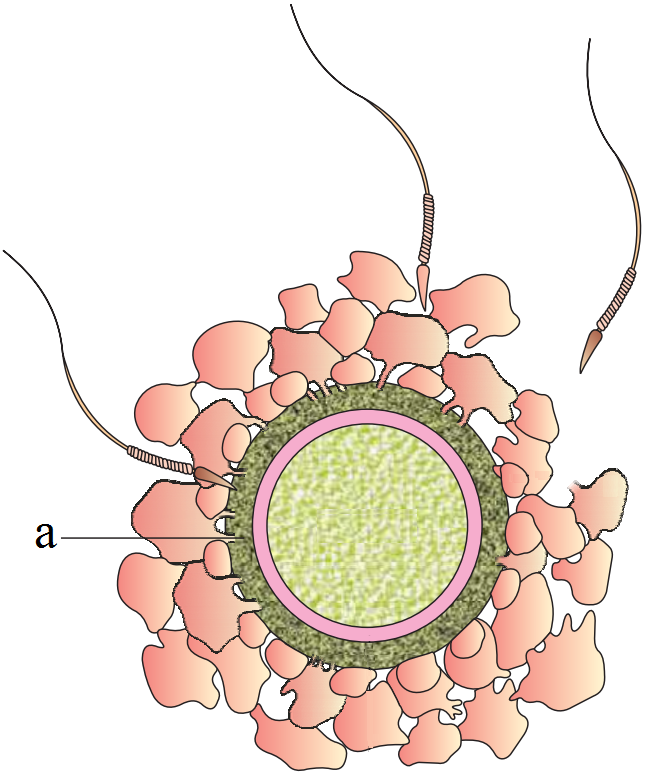
  1. One of the sperms is observed to penetrate 'a' of the ovum, as shown in the above diagram. Name 'a'.
  2. How is the sperm able to do so?
  3. Where exactly in the fallopian tube does this occur?
  4. Explain the events thereafter up to morula stage.
A true breeding homozygous pea plant with green pods and axial flowers as dominant characters, is crossed with a recessive homozygous pea plant with yellow pods and terminal flowers. Work out the cross up to $F_2$ generation giving the phenotypic ratios of $F_1$ and $F_2$ generation respectively.
Answer the following questions:
Describe the stages of oogenesis in human females.
  1. Compare, giving reasons, the J-shaped and S-shaped models of population growth of a species.
  2. Explain "fitness of a species" as mentioned by Darwin.
  1. A garden pea plant bearing terminal, violet flowers, when crossed with another pea plant bearing axial, violet flowers produced axial, violet flowers and axial, white flowers in the ratio of 3 : 1. Work out the cross showing the genotypes of the parent pea plants and their progeny.
  2. Name and state the law that can be derived from this cross and not from a monohybrid cross.
How are Mendelian inheritance, polygenic inheritance and pleiotropy different from each other?
Read the following and answer any four questions from (i) to (v) given below:
Apomixis is a mode of reproduction which does not involve formation of zygote through gametic fusion. In plants, apomixis commonly mimics sexual reproduction but produces seeds without fertilization. There are several methods of atomistic development in seeds. Thee two common ones are recurrent agamospermy and advective embryony.
  1. Apomixis is a type of reproduction in plants, in which?
  1. Fertilization does not take place.
  2. Male nucleus takes part in fertilization.
  3. Pollen fusion takes place.
  4. Generative nucleus takes part in fertilization.
  1. Which of the following statements is incorrect regarding recurrent agamospermy?
  1. It is the formation of seed that has an embryo formed without meiosis and syngamy.
  2. All the cells of embryo sac are diploid.
  3. An embryo develops directly from a diploid cell other than egg like that of nucleus and integument.
  4. None of these.
  1. Adventive embryony is found in:
  1. Citrus.
  2. Opuntia.
  3. Apple.
  4. Both (a) and (b).
  1. Formation of embryo directly from diploid egg without fertilization is called:
  1. Apospory.
  2. Diplospory.
  3. Polyembryony.
  4. Diploid parthenogenesis.
  1. If any somatic cell of sporophyte produces gametophyte without reduction division, it is called:
  1. Parthenogenesis.
  2. Apogamy.
  3. Apospory.
  4. Amphimixis.
Write the causes, symptoms and prevention measures of diphtheria.
Explain with an example, where a gene, which carries a major disadvantage in homozygous state, confers an advantage in heterozygous condition.