Question
Explain the water of Crystallization.
was formed which had the same colour as the solution in the first test tube.
- From this we come to know that no chemical change has occurred in the crystals of blue vitriol due to heating.
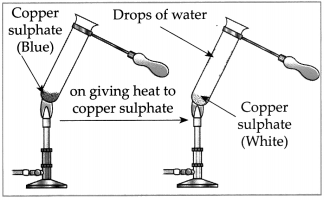
- Losing water on heating blue vitriol, breaking down of the crystal structure, losing blue colour and regaining blue colour on adding water are all physical changes. $CuSO _4 \cdot 5 H _2 O \stackrel{\text { Heat }}{\longrightarrow} CuSO _4+5 H _2 O$
(Blue)
(White)
(anhydrous copper sulphate)
- Similarly, ferrous Sulphate crystals also contain 7 molecules of water of crystallization which are lost on heating.
- The reaction is represented as
$
\begin{aligned}
& FeSO _4 .7 H _2 O \stackrel{\text { Heat }}{\longrightarrow} FeSO _4+7 H _2 O \\
& \text { (Green) } \\
&
\end{aligned}
$
(anhydrous ferrous sulphate)
- Ionic compounds are crystalline in nature. These crystals are formed as a result of definite arrangement of ions.
- In the crystals of some compounds, water molecules are also included in this arrangement.
- That is the water of crystallization. The water of crystallization is present in a definite proportion of the chemical formula of the compound.
Generate a complete, print-ready paper with questions like this in minutes — across 16+ boards, with answer keys.