Question
Explain this statement clearly :
"To call a dimensional quantity 'large' or 'small' is meaningless without specifying a standard for comparison." In view of this, reframe the following statement wherever necessary :
(a) atoms are very small objects
(b) a jet plane moves with great speed 
(c) the mass of Jupiter is very large 
(d) the air inside this room contains a large number of molecules
(e) a proton is much more massive than an electron 
(f) the speed of sound is much smaller than the speed of light.
Answer

(a) The size of an atom is much smaller than the tip of an pin. 
(b) Jet aircraft moves at a higher speed than the speed of a helicopter. 
(c) The mass of Jupiter is more than the mass of the Earth. 
(d) The number of molecules in the air inside a room is more than the number of molecules in one mole of air. 
(e) A proton is much heavier than an electron. This statement is true. 
(f) This statement is already true.

Need a full question paper?

Generate a complete, print-ready paper with questions like this in minutes — across 16+ boards, with answer keys.

Start Generating Free

Similar questions

A big size balloon of mass M is held stationary in air with the help of a small block of mass M/2 tied to it by a light string such that both float in mid air. Describe the motion of the balloon and the block when the string is cut. Support your answer with calculations.
A particle of mass 0.2kg attached to a massless string is moving in a vertical circle of radius 1.2m. It is imparted a speed of 8ms-1 at the lowest point of its circular path. Does the particle complete the vertical circle? What is the change is tension in the string when the particle moves from the position where the string is vertical to the position where the string is horizontal?
Two cars A and B are running at velocities of 60km/ hr and 45km/ hr respectively. Calculate the relative velocity of car A if:
  1. They are both travelling eastwards.
  2. Car A is travelling eastwards and car B is travelling westwards.
  1. Describe a Carnot's cycle.
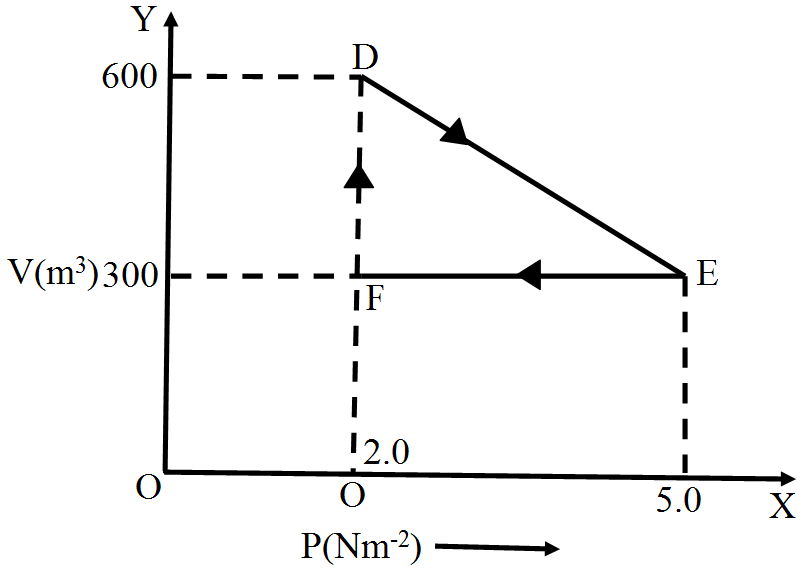
  2. A thermodynamic system is taken from an original state to an intermediate state by the linear process shown in below figure. Its volume is then reduced to the original value from E to F by an isobaric process. Calculate the work done by the gas from D to E to F.

A flywheel of moment of inertia 5.0kg-m2 is rotated at a speed of 60rad/s. Because of the friction at the axle, it comes to rest in 5.0 minutes. Find:
  1. The average torque of the friction.
  2. The total work done by the friction.
  3. The angular momentum of the wheel 1 minute before it stops rotating.
A charge of 3.14 × 10⁻⁶C is distributed uniformly over a circular ring of radius 20.0cm. The ring rotates about its axis with an angular velocity of 60.0 rad/s. Find the ratio of the electric field to the magnetic field at a point on the axis at a distance of 5.00cm from the centre.
A uniform U-tube has a liquid of density $\rho$ and a length L. The cross-sectional area is A. If it is made to oscillate, show that it will be S.H.M. and find its frequency.
Express unified atomic mass unit in kg.
Derive Newton's law of cooling from Stefan-Boltzman law.
A uniformly moving cricket ball is turned back by hitting it with a bat for a very short time interval. Show the variation of its acceleration with time. (Take acceleration in the backward direction as positive).