Question
Explain threshold frequency and stopping potential.###Define the following with respect to photoelectric effect :
(i) Work function (ii) Stopping potential

Answer

Threshold frequency : The minimum frequency below which photon is not capable of emitting an electron is called the threshold frequency. This is represented by $v_0$.
Stopping potential : The negative potential of plate C relative to P at which the photoelectric current becomes zero is called "stopping potential" or "cut off potential".
Work function : The minimum energy required for the emission of photoelectron from a metal is called the 'Work function' of that metal. Generally it represented by W or $\phi_0$. It is expressed in Joule and electron Volt.

Need a full question paper?

Generate a complete, print-ready paper with questions like this in minutes — across 16+ boards, with answer keys.
Start Generating Free

Similar questions

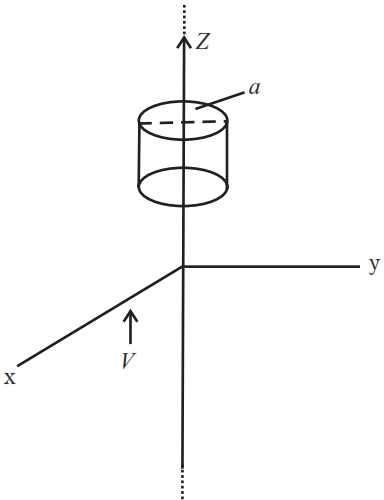
An infinitely long thin wire carrying a uniform linear static charge density λ is placed along the z-axis. The wire is set into motion along its length with a uniform velocity $\text{v}=\text{v}\hat{\text{k}}_\text{z}$. Calculate the poynting vector $\text{S}=\frac{1}{\mu_0}(\text{E}\times\text{B})$.
A nearsighted person cannot see beyond 25cm. Assuming that the separation of them glass from the eye is 1cm, find the power of lens needed to see distant objects.
An $\alpha -$ particle collides with nucleus after passing through the potential $V$ volt. Prove that distance of closest approach of particle of atomic number $Z$ to the nucleus will be $14.4( Z / V ) \ \mathring A $.
$($Given that : $1 / 4 \pi \varepsilon_0=9.0 \times 10^9$ Newton $-$ meter $^2 /$ Coulomb $^2$ and $e=1.6 \times 10^{-19}$ Coulomb$)$
  1. Define ‘activity’ of a radioactive substance.
  2. Two different radioactive elements with half lives $T_1$ and $T_2$ have $N_1$ and $N_2$ undecayed atoms respectively present at a given instant. Derive an expression for the ratio of their activities at this instant in terms of $N_1$ and $N_2.$
A hot gas emits radiation of wavelengths $46.0\ nm, 82.8\ nm$ and $103.5\ nm$ only. Assume that the atoms have only two excited states and the difference between consecutive energy levels decreases as energy is increased. Taking the energy of the highest energy state to be zero, find the energies of the ground state and the first excited state.
An ideal diode should pass a current freely in one direction and should stop it completely in the opposite direction. Which is closer to ideal-vacuum diode or a p-n junction diode?
Consider the situation of the previous problem. Find the average electric field energy stored in the capacitor and the average magnetic field energy stored in the coil.
Estimate the proportion of boron impurity whieh will increase the conductivity of a pure silicon sample by a factor of $100.$ Assume that each boron atom creates a hole and the concentration of holes in pure silicon at the same temperature is $7 \times 10^{15}$ holes per cubic metre. Density of silicon is $5 \times 10^{21}$ atoms per cubic metre.
Calculate the $Q-$value of the fusion reaction
$^4He + ^4He = ^8Be.$
Is such a fusion energetically favourable? Atomic mass of $^8Be$ is $8.0053u$ and that of $^4He$ is $4.0026u.$
Half life of $^{238}\text{U}_{92}$against$\alpha$ decay is $4.5 \times 10^{9}$years. Calculate the activity of Ig sample of$^{238}\text{U}_{92}$? Given Avogadro's number $= 6 \times 10^{26}$atoms/kmol.