Question
Explain threshold frequency.

Answer

Hallwach and Lenard observed that electrons are emitted from a metal plate only if the frequency of ultraviolet light is above a certain frequency.
This specific frequency is called the threshold frequency of a given metal.
The threshold frequency depends on the type of metal, meaning its value is different for each metal.
Thus, to obtain photoelectric effect (emission of electrons) the frequency of ultraviolet light (v) should be greater than (or equal to) the threshold frequency of metal $\left(v_0\right)$.
$v \geq v_0 \text {. }$

Need a full question paper?

Generate a complete, print-ready paper with questions like this in minutes — across 16+ boards, with answer keys.
Start Generating Free

Similar questions

Write the formula for the torque acting on a current-carrying coil placed in uniform magnetic field and explain its stable and unstable equilibrium states.
What is self induction ? Obtain expression for self induced emf.
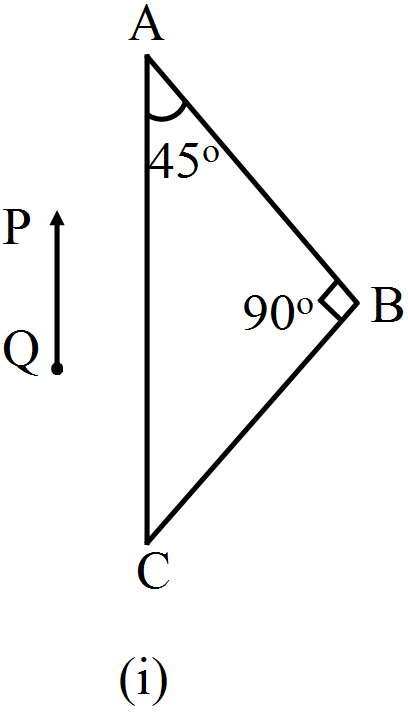
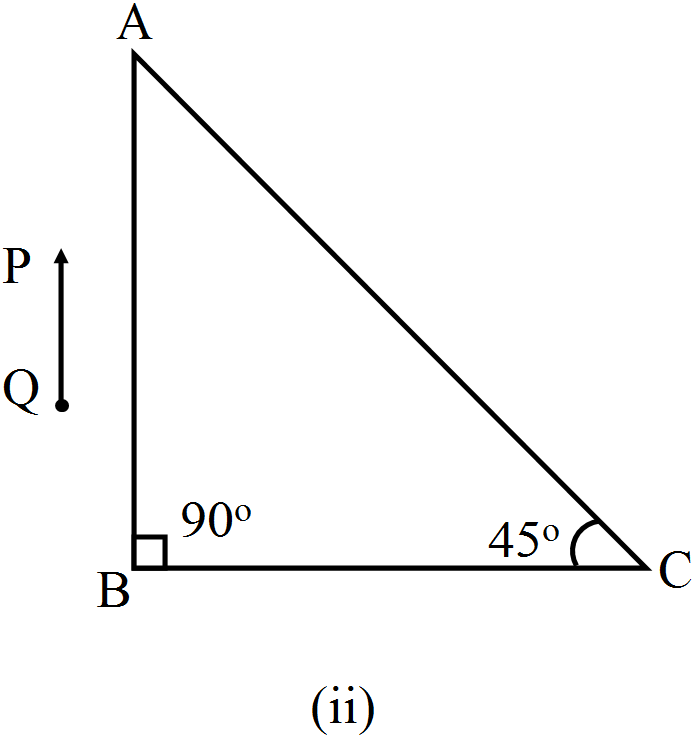
A right-angled crown glass prism with critical angle 41° is placed before an object, PQ in two positions as shown in the figures (i) and (ii). Trace the paths of the rays from P and Q passing through the prisms in the two cases.

How will an air bubble behave like a lens in water?
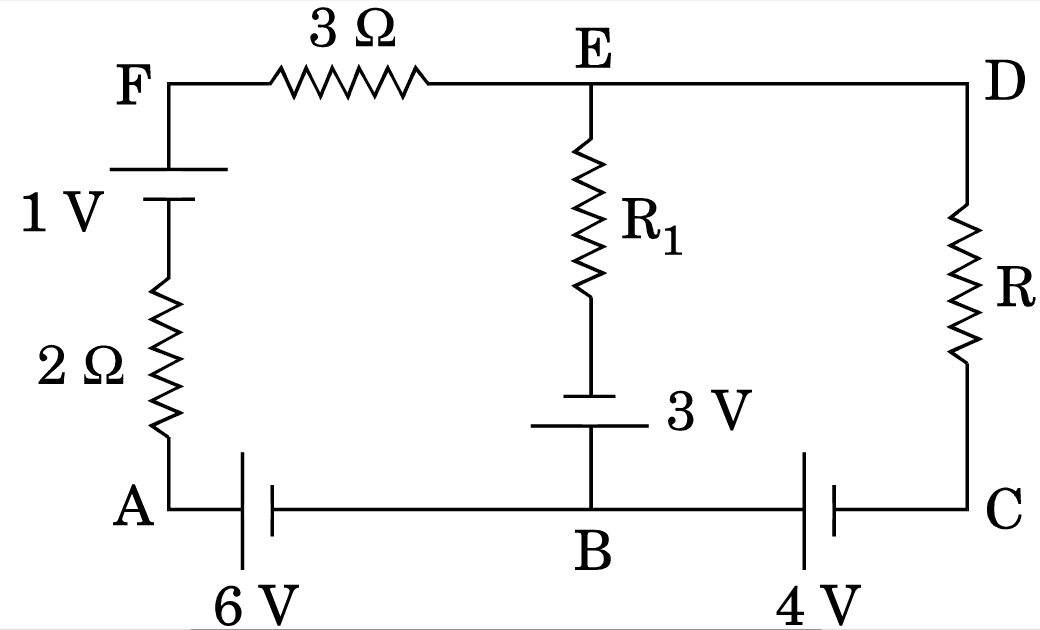
Use Kirchhoff ’s rules to determine the potential difference between the points A and D when no current flows in the arm BE of the electric network shown in the figure.

Can the dispersive power $\omega=\frac{\mu_\text{v}-\mu\text{r}}{\mu-1}$ be negative? What is the sign of co if a hollow prism is immersed into water?
Derive an expression for (i) induced emf and (ii) induced current when a conductor of length l is moved with a uniform velocity, normal to a uniform magnetic field B. Assume the resistance of conductor to be R.
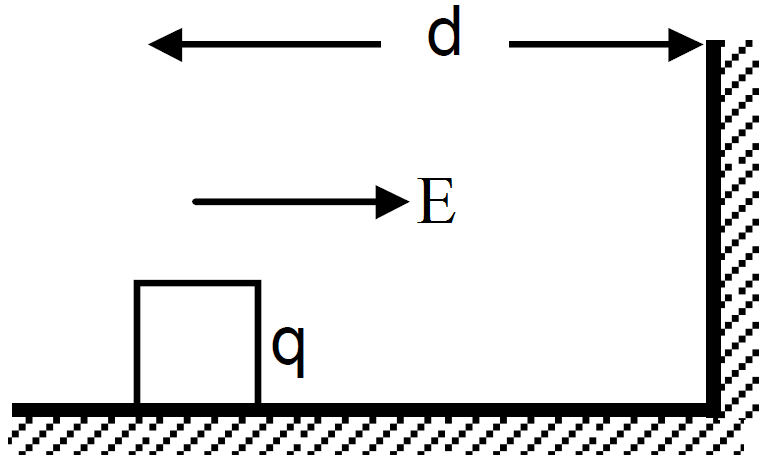
A block of mass m containing a net positive charge q is placed on a smooth horizontal table which terminates in a vertical wall as shown in figure. The distance of the block from the wall is d. A horizontal electric field E towards right is switched on. Assuming elastic collisions (if any) find the time period of the resulting oscillatory motion. Is it a simple harmonic motion?

Answer the following question:
As you have learnt in the text, the principle of linear superposition of wave displacement is basic to understanding intensity distributions in diffraction and interference patterns. What is the justification of this principle?
50m3 of saturated vapour is cooled down from 30°C to 20°C. Find the mass of the water condensed. The absolute humidity of saturated water vapour is 30gm-3 at 30°C and 16gm-3 at 20°C.