→ Transforming Principle
→ In 1928, Frederick Griffith, in a series of experiments with Streptococcus pneumoniae (bacterium responsible for pneumonia), witnessed a miraculous transformation in the bacteria.
→ During the course of his experiment, a living organism (bacteria) had changed in physical form.
→ When Streptococcus pneumoniae (pneumococcus) bacteria are grown on a culture plate,
(I) Some produce smooth shiny colonies (S) while others produce rough colonies (R).
(II) This is because the S strain bacteria have a mucous (polysaccharide) coat, while R strain does not.
→ Mice infected with the S strain (virulent) die from pneumonia infection but mice infected with the R strain do not develop pneumonia.

→ Griffith was able to kill bacteria by heating them.
→ He observed that heat-killed S strain bacteria injected into mice did not kill them.
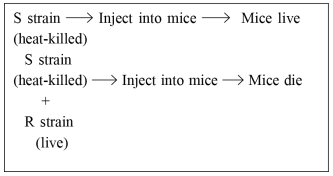
→ When he injected a mixture of heat-killed S and live R bacteria, the mice died. Moreover, he recovered living S bacteria from the dead mice.
→ He concluded that the R strain bacteria had somehow been transformed by the heat-killed S strain bacteria.
→ Some 'transforming principle', transferred from the heat-killed S strain, had enabled the R strain to synthesise a smooth polysaccharide coat and become virulent.
→ This must be due to the transfer of the genetic material. However, the biochemical nature of genetic material was not defined from his experiments,