Maharashtra BoardEnglish MediumSTD 11 SciencePhysicsSound4 Marks
Question
Explain what is meant by phase of a wave.
✓
Answer
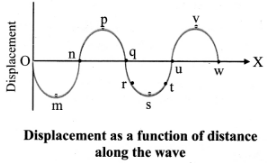
i. The state of oscillation of a particle is called the phase of the particle.
ii. The displacement, direction of velocity and oscillation number of the particle describe the phase of the particle at
a place.
iii. Particles r and t ( q and u or v and s ) have same displacements but the directions of their velocities are opposite.
iv. Particles having same magnitude of displacements and same direction of velocity are said to be in phase during their respective oscillations. Example: particles v and p.
v. Separation between two particles which are in phase is wavelength $(\lambda)$.
vi. The two successive particles differ by $' 1 '$ in their oscillation number i.e., if particle v is at its $n ^{\text {th }}$ oscillation, particle p will be at its $( n +1)^{\text {th }}$ oscillation as the wave is travelling along + $X$ direction.
vii. In the given graph, if the disturbance (energy) has just reached the particle $w$, the phase angle corresponding to particle is $0^{\circ}$. At this instant, particle $v$ has completed quarter oscillation and reached its positive maximum $(\sin \theta=+1)$. The phase angle $\theta$ of this particle $v$ is $\frac{\pi^c}{2}=90^{\circ}$ at this instant.
viii. Phase angles of particles $u$ and $q$ are $\pi^c\left(180^{\circ}\right)$ and $2 rcc \left(360^{\circ}\right)$ respectively.
ix. Particle p has completed one oscillation and is at its positive maximum during its second oscillation.
$\therefore$ phase angle $=2 \pi^c+\frac{\pi^c}{2}$
$=\frac{5 \pi^c}{2} x . v$ and p are the successive particles in the same state (same displacement and same direction of velocity) during their respective oscillations. Phase angle between these two differs by $2 \pi^c$.
Need a full question paper?
Generate a complete, print-ready paper with questions like this in minutes — across 16+ boards, with answer keys.