Question
Explain why 7 × 11 × 13 + 13 and 7 × 6 × 5 × 4 × 3 × 2 × 1 + 5 are composite numbers.

Answer

Explain: Why 7 × 11 × 13 + 13 and 7 × 6 × 5 × 4 × 3 × 2 × 1 + 5 are composite numbers.
We can see that both the numbers have common factor 7 and 1.
7 × 11 × 13 + 13 = (77 + 1) × 13
= 78 × 13
7 × 6 × 5 × 4 × 3 × 2 × 1 + 5 = (7 × 6 × 4 × 3 × 2 × 1) × 2
= 1008 × 5
And we know that composite numbers are those numbers which have at least one more factor other than 1.
Hence after simplification we see that both numbers are even and therefore the given two numbers are composite numbers.

Need a full question paper?

Generate a complete, print-ready paper with questions like this in minutes — across 16+ boards, with answer keys.
Start Generating Free

Similar questions

A metallic cone of radius 12cm and height 24cm is melted and made into spheres of radius 2cm each. How many spheres are formed?
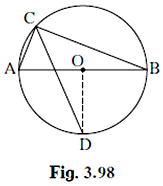
In figure 3.98, seg AB is a diameter of a circle with centre O . The bisector of∠ ACB intersects the circle at point D. Prove that, seg AD ≅seg BD.

Complete the following proof by filling in the blanks.
Proof: Draw seg OD.
$\angle ACB =\square \ldots 90^{\circ} \ldots \ldots \ldots . . \text { angle inscribed in semicircle }$
$\angle DCB =\square \ldots . . .45^{\circ} \ldots CD \text { is the bisector of } \angle C$
$m (\operatorname{arc} DB )=\square . . . .45^{\circ} \ldots \text { inscribed angle theorem }$
$\angle DOB =\square \ldots . . . .90^{\circ} \text { definition of measure of an arc (I) }$
$\operatorname{seg} OA \cong \operatorname{seg} OB \ldots \ldots . . \text { radii of the circle... } \square \text { (II) }$
$\therefore \text { line } OD \text { is } \square \text { of seg } AB . \ldots . . \text { bisector.... From (I) and (II) }$
$\therefore \text { seg } AD \cong \operatorname{seg} BD$
Solve the following simultaneous equation.
5x + 2y = –3; x + 5y = 4
For what value of k are the roots of the quadratic equation $\text{kx}\big(\text{x}-2\sqrt5\big)+10=0$ real and equal?
Prove the following trigonometric identities.
$\frac{(1+\cot^2\theta)\tan\theta}{\sec^2\theta}=\cot\theta$
If a square is inscribed in a circle, find the ratio of the areas of the circle and the square.
The HCF of two numbers is 145 and their LCM is 2175. If one number is 725, find the other.
Prove that:
$=\frac{2\sin68^\circ}{\cos22^\circ}-\frac{2\cot15^\circ}{5\tan75^\circ}\\-\frac{3\tan45^\circ\tan20^\circ\tan40^\circ\tan50^\circ\tan70^\circ}{5}=1$
If $\triangle ABC \sim \triangle DEF$ such that the area of $\triangle ABC$ is $9 cm^2$ and the area of $\triangle D E F$ is $16 cm^2$. If $B C=2.1$ cm . Find length of EF.
In $\triangle PQR$, seg $RS$ bisects $\angle R$.
If $PR =15, RQ =20 PS =12$
then find $S Q$.