Question
Explain why a recessive allele is unable to express itself in a heterozygous state.

Answer

The alleles are present on homologous chromosomes.
The recessive allele does not code for its product or codes for a defective product.
The other allele remains normal and thus expresses itself.

Need a full question paper?

Generate a complete, print-ready paper with questions like this in minutes — across 16+ boards, with answer keys.
Start Generating Free

Similar questions

i. How are the characteristic features of pollen, anther and stigma of a maize plant suited for pollination by wind?
ii. How do you justify that:
1. Pollen grains are recovered from fossils?
2. Micropyle remains as a small pore in the seed coat of a fully developed seed?
In case of polyembryony, If one embryo develops from the synergid and another from the nucellus, which one is haploid and which is diploid? Describe polyembryony and also mention how can it be commercially exploited.
(a) Explain the process of DNA replication in prokaryotes.
(b) Name the phase in the cell cycle in which DNA replication takes place in the cell. What if after DNA replication there is no cell division in a cell?
Read the following and answer any four questions from (i) to (v) given below:

Gene therapy is the technique of genetic engineering to replace a faulty gene by a normal healthy functional gene. It is a way of treating genetic disease by introducing a piece of DNA into the cells of an affected individual. Liposomes can be used for gene therapy as they target the cells affected by a genetic disease.

  1. A patient suffers from adenosine deaminase (ADA) deficiency, an autosomal recessive immune deficiency in which bone marrow lymphoblasts cannot replicate to generate immuno-competent lymphocytes. The treatment option that would cure the patient is:
  1. Germ-line gene therapy to replace one ADA gene copy.
  2. Germ-line gene therapy to replace both ADA gene copies.
  3. Somatic cell gene therapy to replace both ADA gene copies in circulating lymphocytes.
  4. Somatic cell gene therapy to replace one ADA gene copy in bone marrow lymphoblasts.
  1. Which type of gene therapy is least effective in transferring DNA to the nucleus?
  1. Adenoviruses.
  2. DNA attached to a ligand.
  3. Liposomes.
  4. Retroviruses.
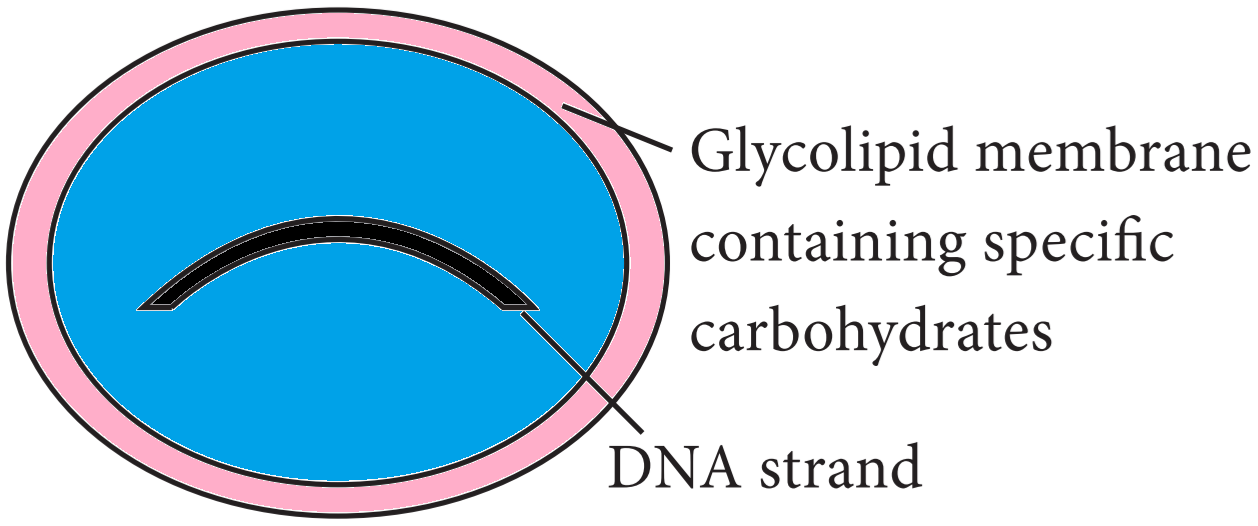
  1. Liposomes can be used for gene therapy as they target the cells affected by a genetic disease. The diagram shows the structure of a liposome.

What feature of a cell surface membrane allows the liposome to target cells affected by a genetic disease? 

  1. Carrier molecules.
  2. Phosphate groups.
  3. Protein channels.
  4. Receptor molecules.
  1. Which of the following disorders would gene therapy be least effective?
  1. Cystic fibrosis.
  2. Huntington's disease.
  3. Sickle cell anaemia.
  4. Type II diabetes.
  1. Following are some reasons explaining why gene therapy is not yet fully an effective treatment for genetic diseases.
  1. Lack of knowledge of DNA sequences.
  2. Lack of efficient and safe gene delivery system.
  3. Cost of the technology.
  4. Some diseases involve multiple genes.
  5. Problems with appropriate gene regulation.

Select the correct option. 

  1. I, III and V only
  2. II, IV and V only
  3. Ill, IV and V only
  4. I, III and IV only
Answer the following questions:
Draw a diagrammatic sectional view of a human seminiferous tubule, and label Sertoli cells, primary spermatocyte, spermatogonium and spermatozoa in it.
Explain with an example, where a gene, which carries a major disadvantage in homozygous state, confers an advantage in heterozygous condition.
What is called immunity? How many types are there? Describe innate immunity.
Identify a, b and c in the table given below:
S. No.
Pattern of inheritance
Monohybrid F1 phenotypic expression
(i)
Co–dominance
a
(ii)
b
The progeny resembled only one of the parents.
(iii)
Incomplete dominance
c
What is cancer? Write the main types of cancer. Name at least three deadly signs of cancer.
Explain the mechanism of sex–determination in humans.