Question
Explain why:
Air pressure in a car tyre increases during driving.

Answer

When a car is in motion, the air temperature inside the car increases because of the motion of the air molecules. According to Charles’ law, temperature is directly proportional to pressure. Hence, if the temperature inside a tyre increases, then the air pressure in it will also increase.

Need a full question paper?

Generate a complete, print-ready paper with questions like this in minutes — across 16+ boards, with answer keys.

Start Generating Free

Similar questions

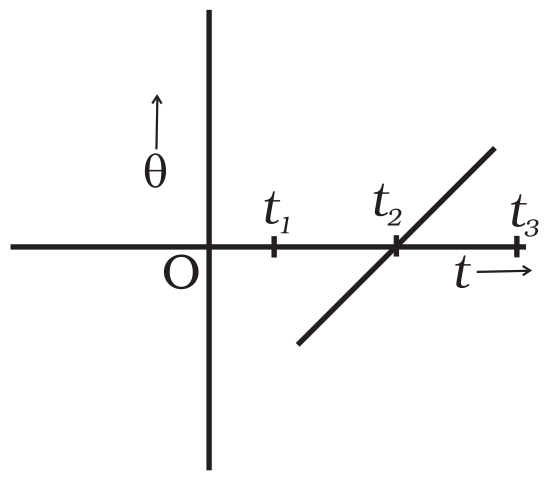
The variation of angular position  of a point on a rotating rigid body, with time t is shown in is the body rotating clock-wise or anti-clockwise?

Find the dimensions of:

  1. The specific heat capacity c.
  2. The coefficient of linear expansion a.
  3. The gas constant R.
Some of the equations involving these quantities are

$\text{Q = mc(T}_2-\text{T}_1),\text{l}_{\text{t}}=\text{l}_0[1+\alpha(\text{T}_2-\text{T}_1)]$ and $\text{PV = nRT}.$
A tuning fork of frequency 256Hz produces 4 beats per second with a wire of length 25cm vibrating in its fundamental mode. The beat frequency decreases when the length is slightly shortened. What could be the minimum length by which the wire be shortened so that it produces no beats with the tuning fork?
It is heard sometime that mercury is used in defining the temperature scale because it expands uniformly with temperature. If the temperature scale is not yet defined, is it logical to say that a substance expands uniformly with temperature?
A Galilean telescope is 27cm long when focused to form an image at infinity. If the objective has a focal length of 30cm, what is the focal length of the eyepiece?
A nucleus is at rest in the laboratory frame of reference. Show that if it disintegrates into two smaller nuclei, the products must be emitted in opposite directions.
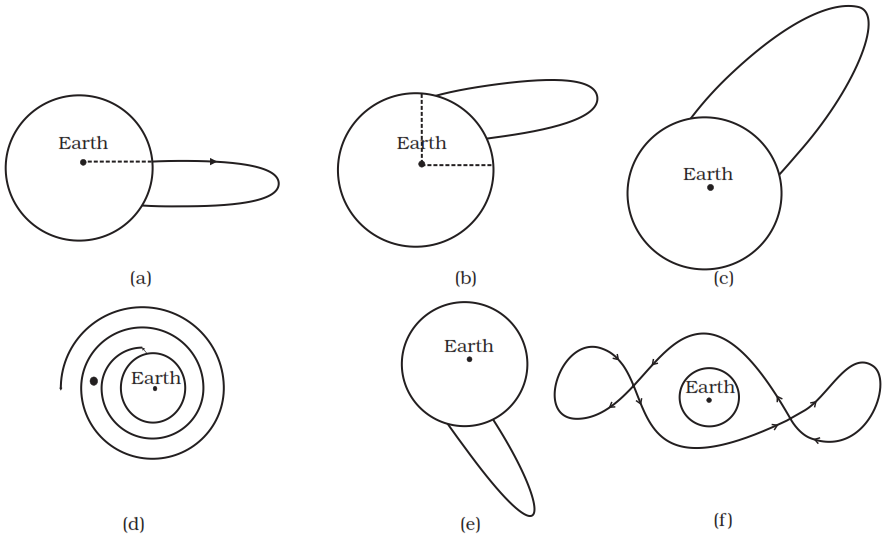
Shown are several curves. Explain with reason, which ones amongst them can be possible trajectories traced by a projectile (neglect air friction).

The torque of a force $\overrightarrow{\text{F}}$ about a point is defined as $\overrightarrow{\text{r}}=\overrightarrow{\text{r}}\times\overrightarrow{\text{F}}.$ Suppose $\overrightarrow{\text{r}}, \overrightarrow{\text{F}}$and $\overrightarrow{\text{r}}$ are all nonzero. Is $\text{r}\times\overrightarrow{\text{r}}\Bigg|\Bigg|\overrightarrow{\text{F}}$ always true? Is it ever true?
Explain the difference between uniform velocity and variable velocity.
Give one argument in favour of the fact that frictional force is a non conservative force.