Question

Explain why antibiotics are more effective in curing bacterial disease than viral diseases?

Answer

Viruses have few genes, sometimes less than 10, and thus few proteins that can be targeted. By contrast, bacteria have thousands of different genes and proteins. There are just more targets to shoot at with bacteria. Bacteria (except in spore stages) must be continuously active metabolically, and thus can be poisoned at any time. Viruses are metabolically inert until they have already infected a host cell, and are not susceptible to the actions of antivirals until then. An exception would be drugs that block viral adhesion to host cells, thus preventing their entry.

Viruses use a lot of host cell proteins for their replication and spread. Any drug that targets host cell proteins will be toxic to the host. Viruses often hijack host genes, and thus their proteins can be closely related to host proteins. Making a drug that discriminates between viral and host versions of a protein is very very difficult. Viruses are far more diverse than bacteria. Whereas most antibiotics are effective against many different species of bacteria, antivirals usually are very specific to one type of virus.

Need a full question paper?

Generate a complete, print-ready paper with questions like this in minutes — across 16+ boards, with answer keys.
Start Generating Free

Similar questions

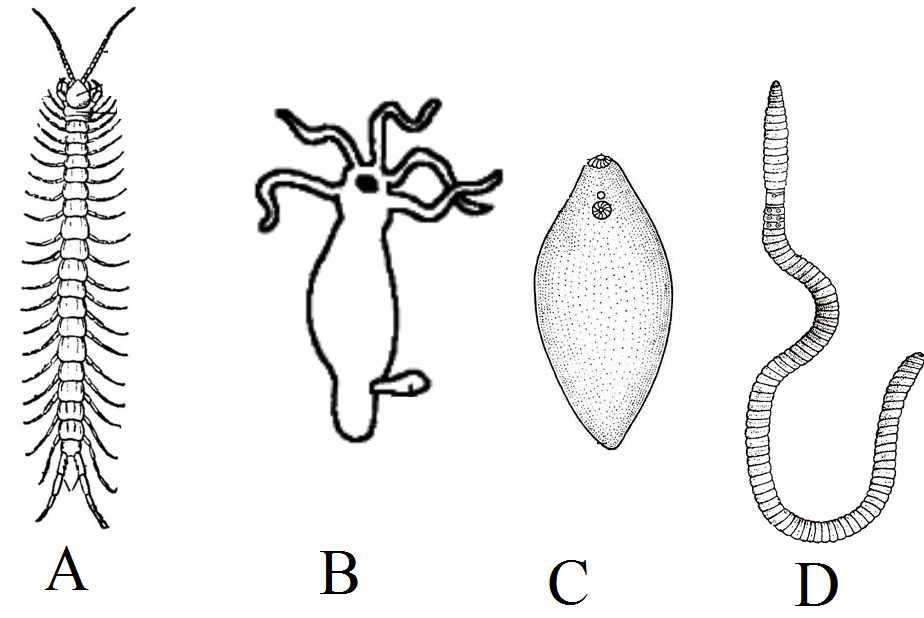
  1. Identify figure A to D.
  2. Which one of them is (i) diplobalstic; (ii) Coelomate?
  3. Which triplobalstic animal is (i) Acoelomate; (ii) Coelomate?
  4. Which one belong to phylum (i) Cnidaria; (ii) Platyhelminthes; (iii) Annelids; (iv) Arthropoda?
  5. Which one of them has (i) Organ level organization? (ii) Organ system level organization?
  6. Which one of them has excretory organs in the form of (i) Flame cells; (ii) Nephridia?
  7. Which one of them has trachea as the respiratory organ? 

Describe the characteristics used in hierarchial classification of organisms.

An atom of element E contains 3 protons, 3 electrons and 4 neutrons:
  1. What is its atomic number?
  2. What is its mass number?
  3. Write the electronic configuration of the element E.
  4. State whether element E is a metal or non-metal. Why?
  5. What type of ion, cation or anion, will be formed by an atom of element E? Why?
  6. Write the symbol of the ion formed by an atom of element E.
  7. What could element X be?
In an experiment, 4.90g of copper oxide was obtained form 3.92g of copper. In another experiment, 4.55g of copper oxide gave, on reduction, 3.64g of copper. Show with the help of calculations that these figures verify the law of constant proportions.
Describe the mechanism of crop variety improvement.
With the help of a labelled diagram, describe the method of separating ammonium chloride from a mixture of ammonium chloride and common salt. Mention the difference in the properties of ammonium chloride and sodium chloride which has made this separations possible.
How can reverberations in a big hall or auditotium be reduced?`
The atom of an element X contains 17 protons, 17 electrons and 18 neutrons whereas the atom of an element Y contains 11 protons, 11 electrons and 12 neutrons.
  1. What type of ion will be formed by an atom of element X? Write the symbol of ion formed.
  2. What will be the number of (i) protons (ii) electrons, and (iii) neutrons, in the ion formed from X?
  3. What type of ion will be formed by an atom of element Y? Write the symbol of ion formed.
  4. What will be the number of (i) protons (ii) electrons, and (iii) neutrons, in the ion formed from Y?
  5. What is the atomic mas of (i) X, and (ii) Y?
  6. What could the elements X and Y be?
Compare all the proposed models of an atom given in this chapter.

Classify connective tissue and give one example of each type.