Question
i. Explain, why $\mathrm{Be}_2$ molecule does not exist by using molecular orbital theory.
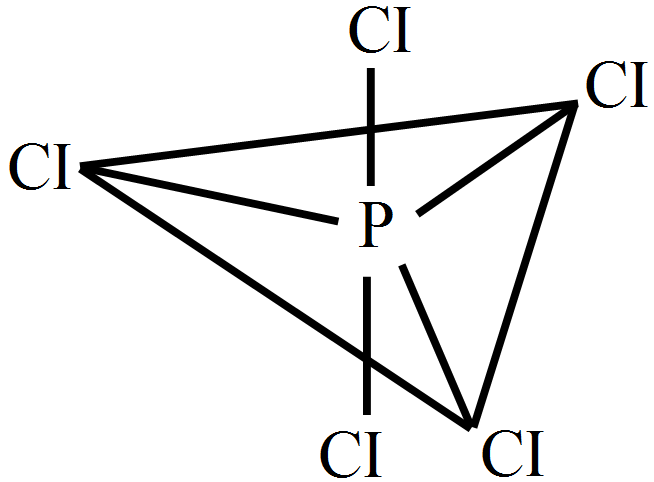
ii. Describe the state of hybridization in $\mathrm{PCl}_5$ Why are the axial bonds longer as compared to equatorial bonds?
Answer

  1. i. Electronic configuration of $\mathrm{Be}=1 \mathrm{~s}^2 2 \mathrm{~s}^2$
M.O. configuration of $\text{Be}_2=(\sigma\text{ls})^2(\sigma*\text{ls})^2(\sigma\text{2s})^2(\sigma*2\text{s})$

Bond order of $\text{Be}_2=\frac12(4-4)=0$

Since bond of $\text{Be}_2=\frac{1}{2}(4-4)=0$
  1. $\text{P}(15)=\text{ls}^2\ \text{2s}^2\ \text{2p}^6\ \text{3s}^2\ \text{3p}^3$
$\therefore$ Hydridization in $\mathrm{PCl}_5$ is $\mathrm{sp}^3 \mathrm{~d}$


Axial bonds experience more electronic repulsion from three equatorial bond pairs and equatorial bonds experience repulsion from only two axial bond pairs hence axial bonds are longer as compared to equatorial bonds.

Need a full question paper?

Generate a complete, print-ready paper with questions like this in minutes — across 16+ boards, with answer keys.

Start Generating Free

Similar questions

  1. Draw the shape of $B_2H_6$ molecule.
  2. Give suitable reasons for the following:
  1. $[\text{SiF}_6]^{2-}$ is known whereas $[\text{SiCl}_6]^{2-}$ not
  2. Diamond is covalent, yet it has high melting point.
  1. Complete the reactions:
  1. $\text{Na}_2\text{B}_4\text{O}_7+7\text{H}_2\text{O}\xrightarrow{\ \ \ \ \ \ \ }$
  2. $\text{B}_2\text{H}_6+3\text{O}_2\xrightarrow{\ \ \ \ \ \ \ \ }$
Why is $\mathrm{Li}_2 \mathrm{CO}_3$ decomposed at a lower temperature whereas $\mathrm{Na}_2 \mathrm{CO}_3$ at higher temperature?
How oxides of nitrogen are generated? What are harmful effects of oxides of nitrogen?
Write down the formulae of the first four members of each homologous series beginning with the following compounds.
  1. $\text{CH}_2=\text{CH}_2$
  2. $\text{HCOOH}$
  3. $\text{CH}_3\text{COCH}_3$
  4. $\text{CH}_3\text{OH}$
  5. $\text{HC}\equiv\text{CH}$
A certain particle carries $2.5 \times 10^{–16}C$ of static electric charge. Calculate the number of electrons present in it.
Define:
  1. Critical pressure.
  2. Critical volume and give their expressions.

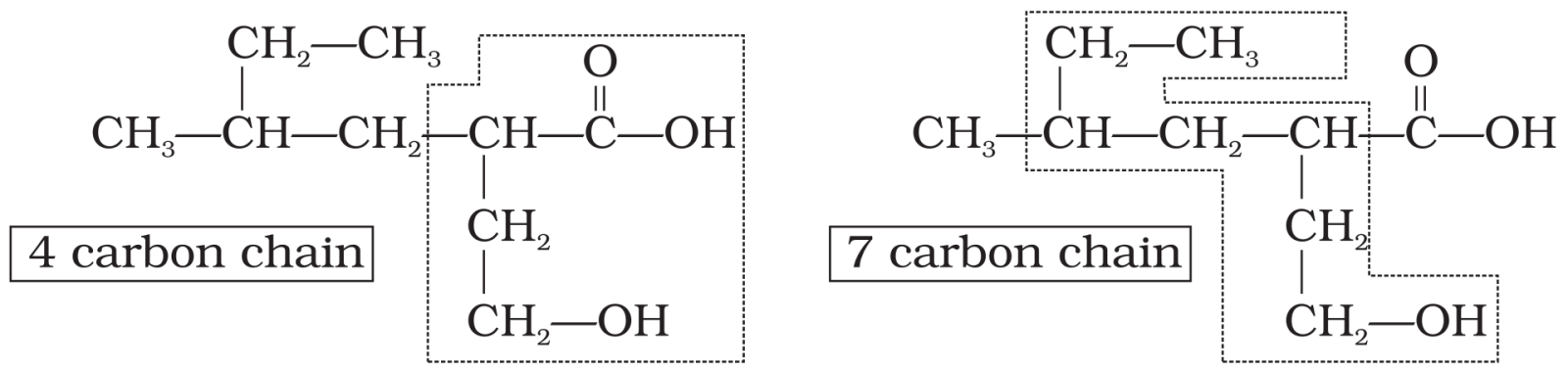
Which of the following selected chains is correct to name the given compound according to IUPAC system.

Give the relationship between $\Delta U$ and $\Delta H$ for gases.
Suggest a method to purify:
  1. Camphor containing traces of common salt.
  2. Kerosene oil containing water.
  3. A liquid which decomposes at its boiling point.
Why are $\mathrm{BeSO}_4$ and $\mathrm{MgSO}_4$ readily soluble in water while $\mathrm{CaSO}_4, \mathrm{SrSO}_4$ and $\mathrm{BaSO}_4$ are insoluble?