Question
  1. Explain, why Be2 molecule does not exist by using molecular orbital theory.
  2. Describe the state of hybridization in PCI5 Why are the axial bonds longer as compared to equatorial bonds?

Answer

  1. Electronic configuration of Be = 1s2 2s2

M.O. configuration of $\text{Be}_2=(\sigma\text{ls})^2(\sigma*\text{ls})^2(\sigma\text{2s})^2(\sigma*2\text{s})$

Bond order of $\text{Be}_2=\frac12(4-4)=0$

Since bond of $\text{Be}_2=\frac{1}{2}(4-4)=0$

  1. $\text{P}(15)=\text{ls}^2\ \text{2s}^2\ \text{2p}^6\ \text{3s}^2\ \text{3p}^3$

$\therefore$ Hydridization in PCl5 is sp3d
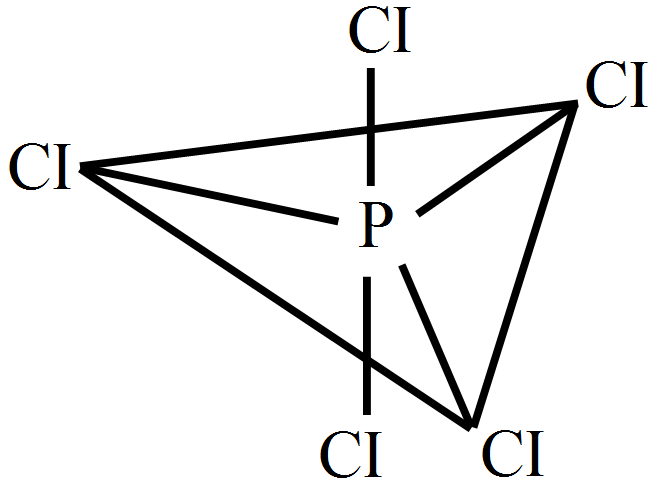
Axial bonds experience more electronic repulsion from three equatorial bond pairs and equatorial bonds experience repulsion from only two axial bond pairs hence axial bonds are longer as compared to equatorial bonds.

Need a full question paper?

Generate a complete, print-ready paper with questions like this in minutes — across 16+ boards, with answer keys.

Start Generating Free

Similar questions

What is the energy in joules, required to shift the electron of the hydrogen atom from the first Bohr orbit to the fifth Bohr orbit and what is the wavelength of the light emitted when the electron returns to the ground state? The ground state electron energy is –2.18 × 10⁻¹¹ergs.
Give the relationship between $\Delta U$ and $\Delta H$ for gases.
Chlorophyll present in green leaves of plants absorbs light at 4.620 × 10¹⁴Hz. Calculate the wavelength of radiation in nanometer. Which part of the electromagnetic spectrum does it belong to?
What are the oxidation number of the underlined elements in the following and how do you rationalise your results?
Fe3O4
Note: Consider structures I to VII and answer the questions:

  1. $\text{CH}_3-\text{CH}_2-\text{CH}_2-\text{CH}_2-\text{OH}$

  2. $\text{CH}_3-\text{CH}_2-\text{CH}-\text{CH}_3\\\ \ \ \ \ \ \ \ \ \ \ \ \ \ \ \ \ \ \ \ \ \ \ \ \ \ |\\\ \ \ \ \ \ \ \ \ \ \ \ \ \ \ \ \ \ \ \ \ \ \ \ \ \text{OH}$

  3. $\ \ \ \ \ \ \ \ \ \ \ \ \text{CH}_3\\\ \ \ \ \ \ \ \ \ \ \ \ \ |\\\text{CH}_3-\text{C}-\text{CH}_3\\\ \ \ \ \ \ \ \ \ \ \ \ \ |\\\ \ \ \ \ \ \ \ \ \ \ \ \text{OH}$

  4. $\text{CH}_3-\text{CH}-\text{CH}_2-\text{OH}\\\ \ \ \ \ \ \ \ \ \ \ \ \ \ \ \ \ \ \ \ \ \ \ \ |\\\ \ \ \ \ \ \ \ \ \ \ \ \ \ \ \ \ \ \ \ \ \ \ \text{CH}_3$

  5. $\text{CH}_3-\text{CH}_2-\text{O}-\text{CH}_2-\text{CH}_3$

  6. $\text{CH}_3-\text{O}-\text{CH}_2-\text{CH}_2-\text{CH}_3$

  7. $\text{CH}_3-\text{O}-\text{CH}-\text{CH}_3\\\ \ \ \ \ \ \ \ \ \ \ \ \ \ \ \ \ \ \ \ \ \ |\\\ \ \ \ \ \ \ \ \ \ \ \ \ \ \ \ \ \ \ \ \ \text{CH}_3$

Identify the pairs of compounds that represents chain isomerism.

Arrange the following:
  1. $\text{C}_6\text{H}_5\stackrel{+\ \ \ \ \ \ \ \ \ \ \ \ }{\text{CHCH}}_3, \text{C}_6\text{H}_5\stackrel{+\ \ \ \ \ \ \ \ \ \ \ \ }{\text{CHCH}}=\text{CH}_2,$ $\text{C}_6\text{H}_5\text{CH}_2\stackrel{+ \ \ \ }{\text{CH}}_2,\text{C}_6\text{H}_5\stackrel{+\ \ \ \ \ \ \ \ \ }{\text{C(CH}}_3)_2$ in order of increasing stability.
  2. $\text{CH}_3\text{CH}_2^+,\text{C}_6\text{H}_5\text{CH}_2^+,(\text{CH}_3)_3\text{C}^+,\text{CH}_2=\text{CHCH}_2^+$ in order of decreasing stability.
  3. $\text{HC}\equiv\text{C}^-,\text{CH}_2=\text{CH}^-,\text{CH}_3\text{CH}_2^-,\text{CH}^-_3,$ $(\text{CH}_3)_2\text{CH}^-,\text{C}_6\text{H}_5\text{CH}^-_2$ in order of increasing stability.
The density of 3 molal solution of NaOH is 1.110g mL–1. Calculate the molarity of the solution.
Note: Consider structures I to VII and answer the questions:

  1. $\text{CH}_3-\text{CH}_2-\text{CH}_2-\text{CH}_2-\text{OH}$

  2. $\text{CH}_3-\text{CH}_2-\text{CH}-\text{CH}_3\\\ \ \ \ \ \ \ \ \ \ \ \ \ \ \ \ \ \ \ \ \ \ \ \ \ \ |\\\ \ \ \ \ \ \ \ \ \ \ \ \ \ \ \ \ \ \ \ \ \ \ \ \ \text{OH}$

  3. $\ \ \ \ \ \ \ \ \ \ \ \ \text{CH}_3\\\ \ \ \ \ \ \ \ \ \ \ \ \ |\\\text{CH}_3-\text{C}-\text{CH}_3\\\ \ \ \ \ \ \ \ \ \ \ \ \ |\\\ \ \ \ \ \ \ \ \ \ \ \ \text{OH}$

  4. $\text{CH}_3-\text{CH}-\text{CH}_2-\text{OH}\\\ \ \ \ \ \ \ \ \ \ \ \ \ \ \ \ \ \ \ \ \ \ \ \ |\\\ \ \ \ \ \ \ \ \ \ \ \ \ \ \ \ \ \ \ \ \ \ \ \text{CH}_3$

  5. $\text{CH}_3-\text{CH}_2-\text{O}-\text{CH}_2-\text{CH}_3$

  6. $\text{CH}_3-\text{O}-\text{CH}_2-\text{CH}_2-\text{CH}_3$

  7. $\text{CH}_3-\text{O}-\text{CH}-\text{CH}_3\\\ \ \ \ \ \ \ \ \ \ \ \ \ \ \ \ \ \ \ \ \ \ |\\\ \ \ \ \ \ \ \ \ \ \ \ \ \ \ \ \ \ \ \ \ \text{CH}_3$

Identify the pairs of compounds which are functional group isomers.

Arrange 2, 2-dimethylbutane, 3-methylpentane and n-hexane in increasing order of their boiling point.
Neon gas is generally used in the sign boards. If it emits strongly at 616 nm , calculate (a) the frequency of emission, (b) distance travelled by this radiation in 30 s , (c) energy of quantum and (d) number of quanta present if it produces 2 J of energy.