Question
Explain why $\text{CO}^{2-}_3$ ion cannot be represented by a single Lewis structure. How can it be represented?
Answer

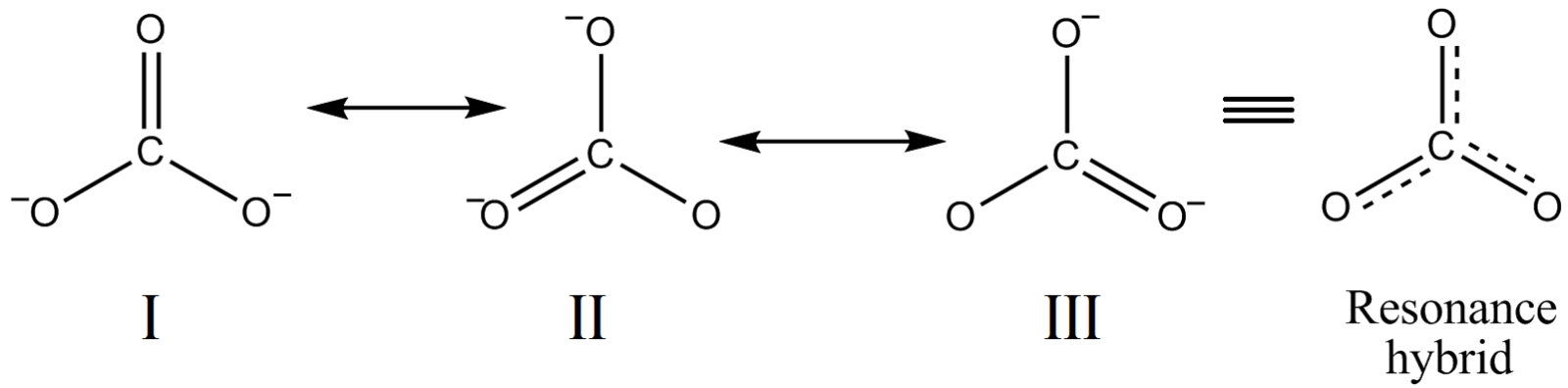
A single Lewis structure of $\text{CO}^{2-}_3$ ion cannot explain all the properties of this ion. It can be represented as a resonance hybrid of the following structures

If, it were represented only by one structure, there should be two types of bonds, i.e. $\text{C}=\text{O}$ double bond and $\text{C}-\text{O}$ single bonds but actually all bonds are found to be identical with same bond length and same bond strength.

Need a full question paper?

Generate a complete, print-ready paper with questions like this in minutes — across 16+ boards, with answer keys.
Start Generating Free

Similar questions

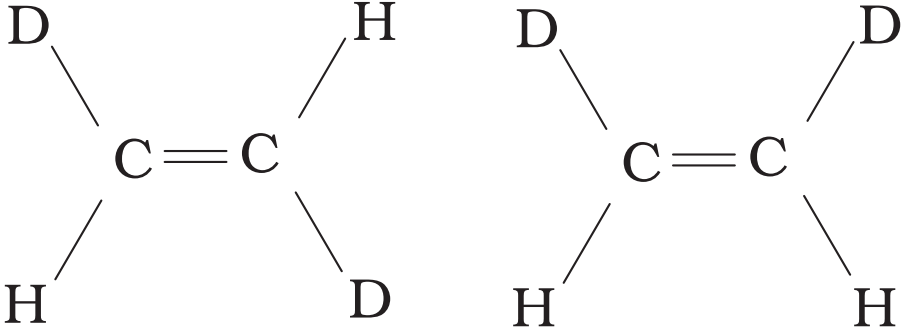
What is the relationship between the members of following pairs of structures? Are they structural or geometrical isomers or resonance contributors?

The Ksp values of two slightly soluble salts AB and PQ2 are each equal to 4.0 × 10⁻¹⁸. Which salt is more soluble?
Answer the following questions:
  1. B, Al, Ga arrange in decreasing order of atomic radii.
  2. C, F, O first electron gain enthalpy in increasing order.
  3. Al forms amphoteric oxide, why?
Using molecular orbital theory, compare the bond energy and magnetic character of O+2 and O2.
Air contains 20% oxygen by volume. Calculate the theoretical volume of air which will be required for burning completely 500m of acetylene gas.

All volumes are measured under the same conditions of temperature and pressure.

Use Lewis symbols to show electron transfer between the following atoms to form cations and anions:
K and S.
Calculate the wavenumber for the longest wavelength transition in the Balmer series of atomic hydrogen.
Give the number of electrons in the species $\text{H}^+_2,\text{H}_2$ and $\text{O}^+_2$
What is the maximum concentration of equimolar solutions of ferrous sulphate and sodium sulphide so that when mixed in equal volumes, there is no precipitation of iron sulphide? (For iron sulphide, $\left.K_{s p}=6.3 \times 10^{-18}\right)$
Write the molecular orbital electronic configurations of the following species:
  1. $\text{N}_2$
  2. $\text{N}^+_2$
  3. $\text{N}^-_\text{2}$
  4. $\text{N}^{2-}_2$
  1. Calculate their bond orders. ​​​​​​
  2. Predict their magnetic behaviour.
  3. Which of these shows highest para-magnetism?