Question
Explain, why does a wise farmer water his fields, if forecast is forst?

Answer

The frost can seriously damage the leaves and fruit of plants. When a farmer waters his fields, during, night, this water gives large amount of heat energy, because 1 g of water will liberate 4.2 J of energy for every 1°C fall in temperature. Thus, the air around the field is saturated with heat energy and its temperature does not fall below 0°C. Thus, no frost is formed.

Need a full question paper?

Generate a complete, print-ready paper with questions like this in minutes — across 16+ boards, with answer keys.

Start Generating Free

Similar questions

Give three examples of bodies possessing potential energy.

The following diagram shows the core of a transformer and its input and output connections.
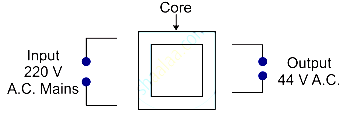


(a) state the material used for core and describe its structure.
(b) complete the diagram of the transformer and connections by labelling all parts joined by you.
(c) Name the transformer: Step-up or step down?
 A rifle shot is fired in a valley between two parallel walls. The echo from one wall is heard in 3 s and the echo from the other wall is heard 3 s later. If the velocity of sound at 00 c is $330 ms^{-1}$ and the temperature in the valley is 100 c , calculate the width of the valley. For every 10 c rise in temperature, the velocity of sound increase by $0.61 ms^{-1}$.
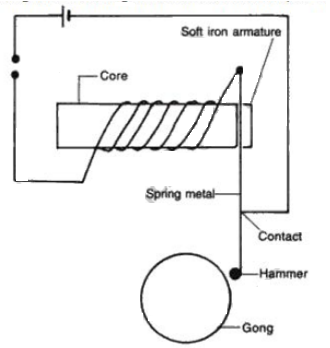
Fig . shows the essent ial features of a battery operated bell. The hammer strikes the gong when the swi tch is closed . State and explain the effect of using the following material successively to form the core.

Image

(a) Plastic
(b) Steel
(c) Copper

What happens to the power if the time for doing work is reduced from t second to t/10 second?
Ice cream appears coder to the mouth than water at 0℃. Give reason.
(a) What is ultraviolet spectrum? What is the range of its wavelengths in $A$ ?
(b) Stale four important properties of ultraviolet rays.
(c) State four uses of ultraviolet rays.
A pin 2 cm long is placed 12 cm away from a convex lens at right angles to the principal axis. If the focal length of the lens is 20 cm, by scale drawing find the size of the image and its magnification.
Define Velocity Ratio
Do we expect any change in the position, nature, and size of the image
(i) formed by a concave lens,
(ii) with a change in the position of the object?