Question
Explain why HCl is a gas and HF is a liquid.

Answer

In HF, fluorine has highest electronegative character which has the capacity to establish Hydrogen bon with other HF molecule.
This property is not observed in HCl therefore HF exist in liquid state while HCl exist in gaseous state.

Need a full question paper?

Generate a complete, print-ready paper with questions like this in minutes — across 16+ boards, with answer keys.
Start Generating Free

Similar questions

Explain the following on the basis of valence bond theory:
i. $\mathrm{BF}_3$ is planar but $\mathrm{NH}_3$ is not.
ii. $\mathrm{CCl}_4$ and $\mathrm{SiCl}_4$ are tetrahedral.
iii. The HSH bond angle is $\mathrm{H}_2 \mathrm{~S}$ is closer to $90^{\circ}$ than HOH bond angle in $\mathrm{H}_2 \mathrm{O}$.
Arrange the following as stated.
  1. Increasing order of bond dissociation energy of $N_2, O_2, F_2, Cl_2.$
  2. Decreasing order of electropositive character of $Cu$, Fe, Mg.
  3. Increasing order of valency of nitrogen in $HNO_3, HNO_2, NO_2.$
Write down the quantum numbers n, and I for the following orbitals.
i. $3 d_{x^2-y^2}$
ii. $4 \mathrm{~d}_{\mathrm{z}^2}$
iii. $3 \mathrm{~d}_{\mathrm{xy}}$
iv. $4 d_{x z}$
v. $2 p_z$
vi. $3 p_x$
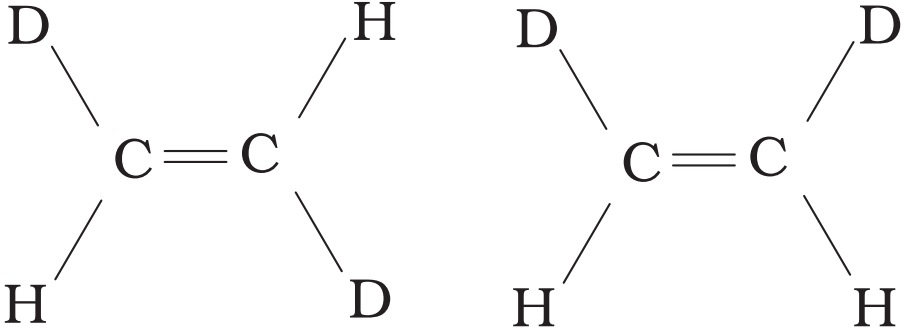
What is the relationship between the members of following pairs of structures? Are they structural or geometrical isomers or resonance contributors?
On the basis of Le Chatelier principle explain how temperature and pressure can be adjusted to increase the yield of ammonia in the following reaction.
$\text{N}_2\text{(g)}+\text{3H}_2\text{(g)}\rightleftharpoons\text{2NH}_3\text{(g)} \ \ \ \ \ \ \ \Delta\text{H}= – 92.38\text{kJ mol}^{–1}$
What will be the effect of addition of argon to the above reaction mixture at constant volume?
The heat of combustion of $\mathrm{C}_2 \mathrm{H}_6$ is -368.4 kcal . Calculate heat of combustion of $\mathrm{C}_2 \mathrm{H}_4$, heat of combustion of $\mathrm{H}_2$ is $68.32 \mathrm{kcal} \mathrm{mol}{ }^{-1} . \Delta \mathrm{H}$ for the following reaction is $-37.1 \mathrm{kcal} . \mathrm{C}_2 \mathrm{H}_4(\mathrm{~g})+\mathrm{H}_2(\mathrm{~g}) \longrightarrow \mathrm{C}_2 \mathrm{H}_6(\mathrm{~g})$
The first (IE) and second (IER) ionization enthalpy: $\left( KJ mol ^{-1}\right)$ of three elements $A , B$ and C are given below:
 ABC
$IE _1$4035491142
$IE _2$264010602080
Identify the element which is likely to be
i. a non-metal
ii. an alkali metal
iii. an alkaline earth metal
An alkyl halide $(\mathrm{X})$ of formula $\mathrm{C}_3 \mathrm{H}_{13} \mathrm{Cl}$ on treatment with alcoholic KOH or potassium tert-butoxide gives two isomeric alkenes Yand $\mathrm{Z}\left(\mathrm{C}_6 \mathrm{H}_{12}\right)$. Both alkenes on hydrogenation give 2, 3-dimethylbutane. Predict the structure of $X$ , $Y$ and $Z$.
a. Which out of the following can be used to those sodium metal and why $C _2 H _5 OH , C _6 H _6, H _2 O$
b. Why does tendency to form hydrates of halides of group decreases down the group.
c. A compound 'A' is used for recover ammonia from $NH _4 Cl$ in Solvay's process. Identify 'A' and write chemical equation for the reaction.
Yellow light emitted from a sodium lamp has a wavelength $(\lambda)$ of $580 nm$. Calculate the frequency (ν) and wavenumber $(\bar{\text{v}})$ of the yellow light.