Question
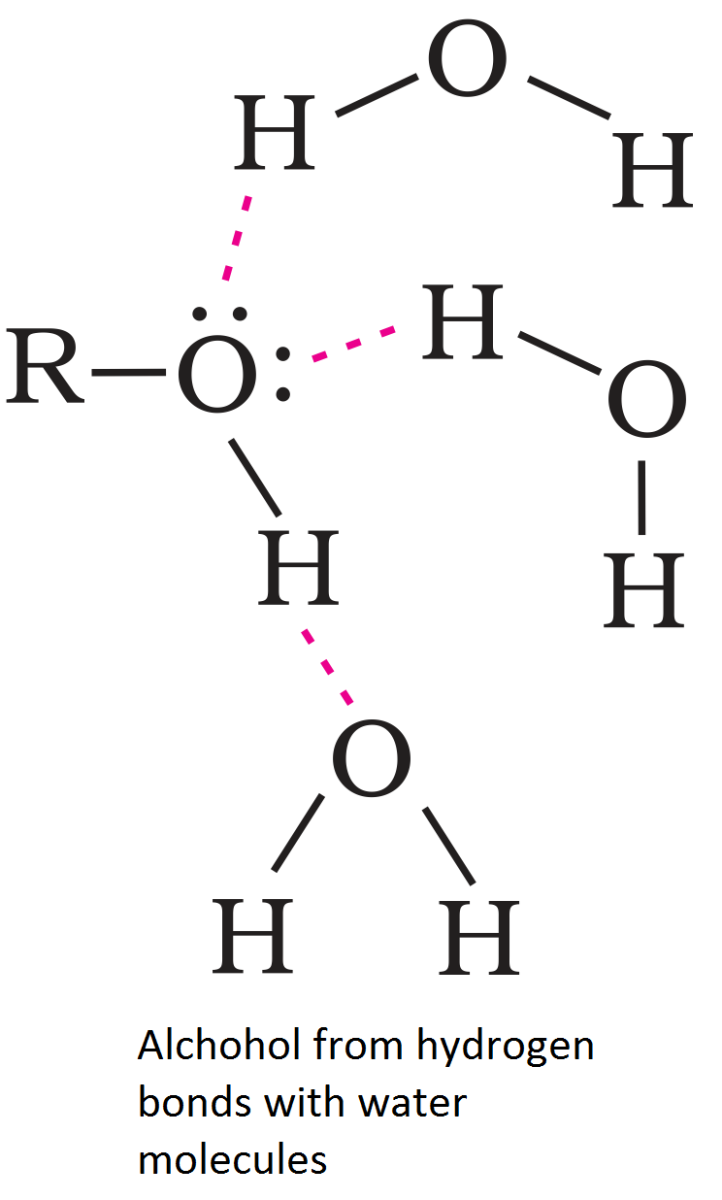
Explain why low molecular mass alcohols are soluble in water.

Need a full question paper?

Generate a complete, print-ready paper with questions like this in minutes — across 16+ boards, with answer keys.

Start Generating Free

Similar questions

Give examples and suggest reasons for the following features of the transition metal chemistry:
A transition metal exhibits highest oxidation state in oxides and fluorides.
State the factors that determine the basicity of alkyl amine compounds in aqueous medium and explain the order of basicity of alkyl amine compounds based on these factors.
Write the chemical equations involved in the following reactions:

  1. Hoffmann-bromamide degradation reaction.
  2. Carbylamine reaction.


On what factors do the products obtained from electrolysis a solution of an electrolyte depend?
Following data are obtained for the reaction:
N2O5 $\rightarrow$ 2NO2 + ½O2
t/s 0 300 600
[N2O5]/mol L–1 1.6 × 10⁻² 0.8 × 10⁻² 0.4 × 10⁻²
  1. Show that it follows first order reaction.
  2. Calculate the half-life.
(Given log 2 = 0.3010 log 4 = 0.6021)
Explain giving reason:

Transition metals and their many compounds act as good catalyst.
Explain the direction of current and flow of electrons in Daniell cell.
Two half-reactions of an electrochemical cell are given below:
MnO4- (aq) + 8 H+ (aq) + 5e → Mn2+ (aq) + 4H2O (l), Eo = +1.51 V,
Sn2+ (aq) → Sn4+ (aq) + 2e, E= +0.15 V.
Construct the redox reaction equation from the two half-reactions and calculate the cell potential from the standard potentials and predict if the reaction is reactant or product favoured.
Give the structures of A, B and C in the following reaction:
$\text{C}_6\text{H}_5\text{N}_2\text{Cl}\xrightarrow[]{\text{CuCN}}\text{A}\xrightarrow[]{\text{H}_2\text{O}/\text{H}^+}\text{B}\xrightarrow[\Delta]{\text{NH}_3}\text{C}$
Compare the general characteristics of the first series of the transition metals with those of the second and third series metals in the respective vertical columns. Give special emphasis on the following points:
Ionisation enthalpies.