Question
Explain why strings of different thicknesses are provided on a stringed instrument.

Answer

So as to produce the sound of the desired frequency. By plucking the string of more thickness, the frequency of the sound produced decreases.

Need a full question paper?

Generate a complete, print-ready paper with questions like this in minutes — across 16+ boards, with answer keys.
Start Generating Free

Similar questions

A radioactive element ${ }_{ Z }^{ A } x$, loses two successive $\beta$-particles and then an alpha particle, such that the resulting nuclide is ${ }_{ Q }^{ P } Y$. Calculate the values of P and Q .
(a) What do you understand by the term refraction of light?
(b) How does the light deviate when it travels from :
(i) a rarer to a denser medium
(ii) a denser to a rarer medium?
Explain why scissors for cutting cloth may have blades longer than the handles, but shears for cutting metals have short blades and long handles.
Name and define the characteristic which enables one to distinguish two sounds of same loudness, but of different frequencies, given by the same instrument.
Why are thick copper wires used as connecting wires?
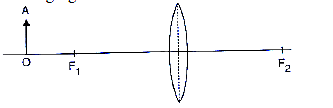
The diagram given below shows the position of an object OA in relation to a converging lens whose foci are at $F_1$ and $F_2.$​​​​​​​


Describe how the distance of the image from the lens and the size of the image change as the object is moved towards $F_1$.
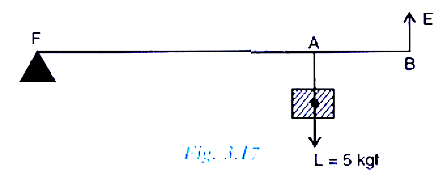
Fig 3.17 below shows a lever in use.


(a) To which class of lever does it belong?
(b) If $FA =80 cm , AB =20 cm$, find its mechanical advantage.
(c) Calculate the value of $E$.
What are conjugate foci?
What determines the pitch of a sound?
A body is acted upon by two forces, each of magnitude F, but in opposite directions. State the effect of the forces when
(a) Both forces act at the same point of the body.
(b) The two forces act at two different points of the body at a separation d.