Question

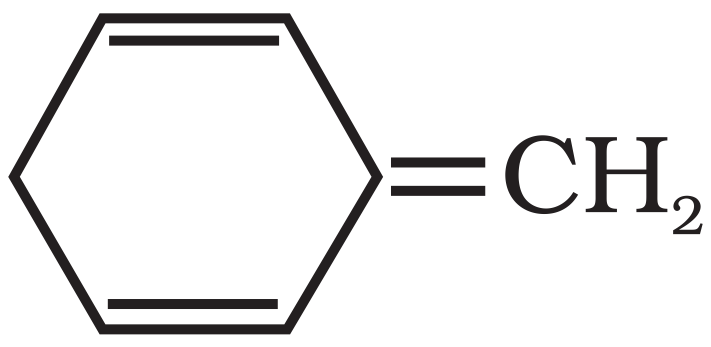
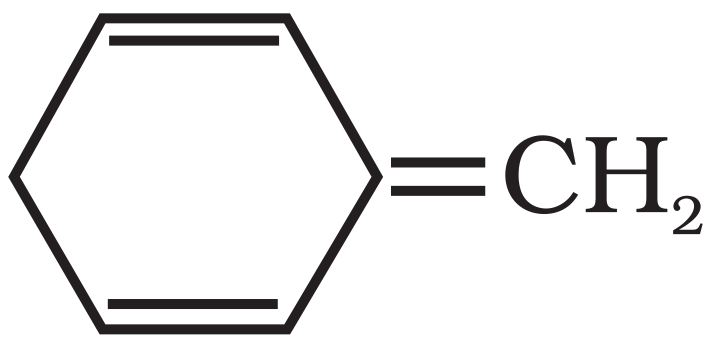
Explain why the following systems are not aromatic?

Answer


Due to the presence of a sp3-hybridized carbon, the system is not planar. It does contain six n-electrons but the system is not fully conjugated since all the six n-electrons do not form a single cyclic electron cloud which surrounds all the atoms of the ring. Therefore, it is not an aromatic compound.

Need a full question paper?

Generate a complete, print-ready paper with questions like this in minutes — across 16+ boards, with answer keys.
Start Generating Free

Similar questions

What will be the pOH of $\frac{ M }{100} \quad H _2 SO _4$ solution ?
Name the Intermolecular forces present in:
  1. $\mathrm{H}_2 \mathrm{O}$
  2. HCl.
Name an element from Group 2 which forms an amphoteric oxide and awater soluble sulphate.
Complete the following reactions:
  1. $(\text{CH}_3)_2\text{C}=\text{CH}-\text{CH}_3\xrightarrow[\text{heat}]{\text{KMnO}_4/\text{KOH}}$
  2. $(\text{CH}_3)_2\text{C}=\text{CH}-\text{CH}_3\xrightarrow{\text{cold KMnO}_4/\text{KOH}}$
Why do real gases deviate from the ideal behaviour? What are the conditions under which real gases show ideal behaviour?
Use the following thermodynamic data to calculate the enthalpy change for the formation of solid lithium fluoride, LiF(s) from Li(s) and $\text{F}_2$(g):$\text{Li(s)}+\frac{1}{2}\text{F}_2(\text{g})\overrightarrow{\ \ \ \ \ \ \ }\ \text{LiF(s)}$
$\text{Li(s)}\overrightarrow{\ \ \ \ \ \ \ \ }\ \text{Li(g)};$ $\Delta_\text{s}\text{H}^\circ=155\text{kJ mol}^{-1}$
$\frac{1}{2}\text{F}_2(\text{g})\overrightarrow{\ \ \ \ \ \ \ }\ \text{F(g)};$ $\Delta\text{H}^\circ=75\text{kJ}$
$\text{Li(g)}\overrightarrow{\ \ \ \ \ } \ \text{Li}^{+}(\text{g})+\text{e}^-;$ $\Delta\text{H}^\circ=520\text{kJ mol}^{-1}$
$\text{F(g)}+\text{e}^-\overrightarrow{\ \ \ \ \ \ } \ \text{F}^-(\text{g});$ $\Delta\text{H}^\circ=-333\text{kJ mol}^{-1}$
$\text{Li}^+\text{(g)}+\text{F}^-(\text{g})\overrightarrow{\ \ \ \ \ \ \ \ }\ \text{LiF(s)};$ $\Delta\text{H}^\circ=-1012\text{kJ mol}^{-1}$
i. Which is largest in size $\mathrm{Cu}^{+}, \mathrm{Cu}^{2+}$ or Cu , and why?
ii. Which element in periodic table has highest I.E. (ionisation energy)?
iii. Which element is more metallic-Mg or Al and why?
On monochlorination of a alkane $C _4 H _{10}( X )$, compound $C _4 H _9 Cl ( Y )$ is obtained. When compound Y is treated with sodium in presence of dry ether 3, 4dimethyhexane is obtained. Identify compound $X$ and Y and give equations.
Give reasons for the following:
  1. The enthalpy of neutralisation is always constant, i.e. 57.1kJ/ mol when a strong acid neutralism a strong base.
  2. Neither q nor w is a state function but q + w is a state function.
An alkene (molecular weight $=56$ ) on reaction with trioxygen followed by zinc/ $CH _3 COOH$ gave only ethanal. Identify the Structure of the alkene.