Question
Explain why. There is fall in temperature with increase in altitude.

Answer

The temperature of atmosphere is due to the kinetic energy of air molecule. Due to lower atmospheric pressure at higher altitude molecules of air rises up so their potential energy increase in turn the kinetic energy decrease results the decrease in temperature. Due to lower atmospheric pressure at higher altitude the gas expands and gives cooling effect and so decrease the temperature.

Need a full question paper?

Generate a complete, print-ready paper with questions like this in minutes — across 16+ boards, with answer keys.

Start Generating Free

Similar questions

Specific heat of Argon at constant Pressure is $0.125 cal / g / K$ and at constant volume is $0.075 cal / g / K$. Calculate the density of Argon at N.T.P. Given that $J =4.2$ Joule/cal?
A particle is subjected to two simple harmonic motions of same time period in the same direction. The amplitude of the first motion is $3.0\ cm$ and that of the second is $4.0\ cm.$ Find the resultant amplitude if the phase difference between the motions is:
  1. $0^\circ$
  2. $60^\circ$
  3. $90^\circ$
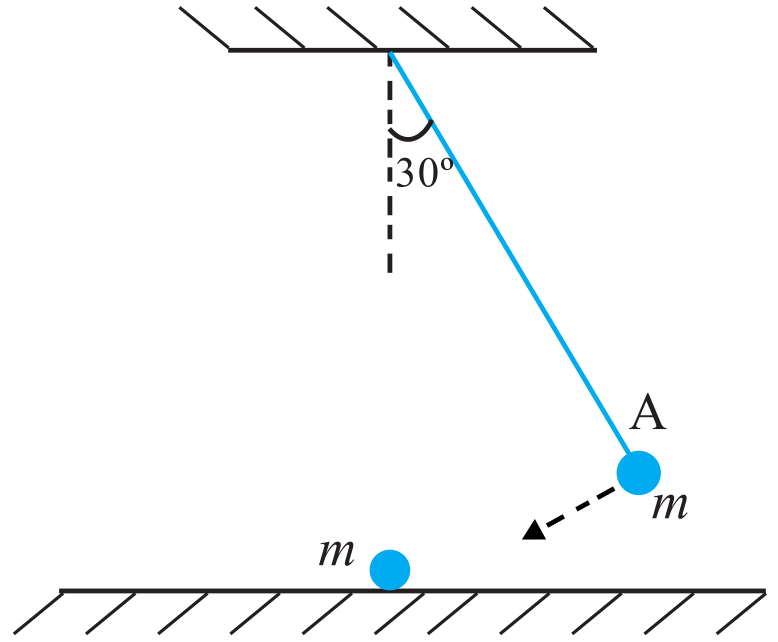
The bob A of a pendulum released from 30° to the vertical hits another bob B of the same mass at rest on a table as shown in. How high does the bob A rise after the collision? Neglect the size of the bobs and assume the collision to be elastic.
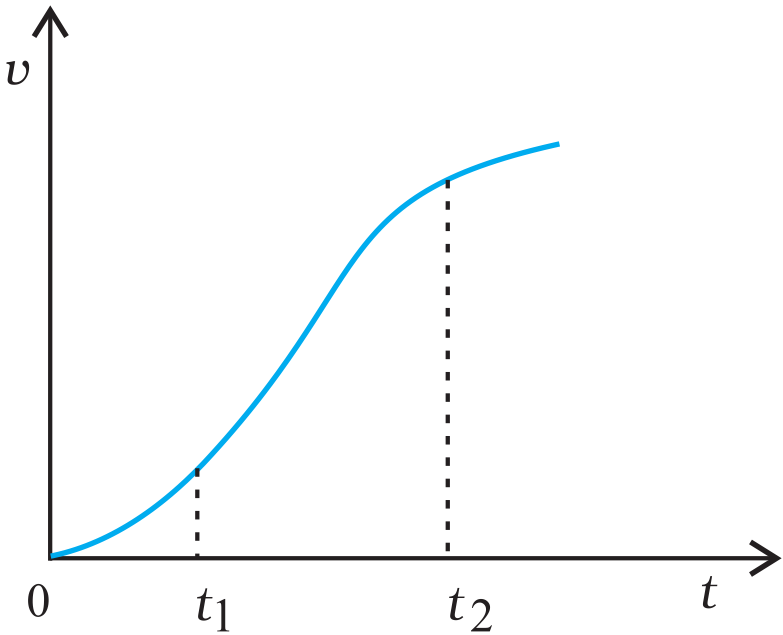
The velocity-time graph of a particle in one-dimensional motion is shown in:

Which of the following formulae are correct for describing the motion of the particle over the time-interval $t_1$ to $t_2$:
a. $x\left(t_2\right)=x\left(t_1\right)+v\left(t_1\right)\left(t_2-t_1\right)+(1 / 2) a\left(t_2-t_1\right)^2$
b. $v\left(t_2\right)=v\left(t_1\right)+a\left(t_2-t_1\right)$
c. $v_{\text {average }}=\left(x\left(t_2\right)-x\left(t_1\right)\right) /\left(t_2-t_1\right)$
d. $\mathrm{a}_{\text {average }}=\left(\mathrm{v}\left(\mathrm{t}_2\right)-\mathrm{v}\left(\mathrm{t}_1\right)\right) /\left(\mathrm{t}_2-\mathrm{t}_1\right)$
e. $x\left(t_2\right)=x\left(t_1\right)+v_{\text {average }}\left(t_2-t_1\right)+(1 / 2) a_{\text {average }}\left(t_2-t_1\right)^2$
f. $x\left(t_2\right)-x\left(t_1\right)=$ area under the v-t curve bounded by the $t$-axis and the dotted line shown.
What is the difference between rotational kinetic energy and rolling kinetic energy? Show that rolling kinetic energy of a rolling body is given by $\frac{1}{2}\text{mv}^2\Big(\frac{\text{K}^2}{\text{r}^2}+1\Big)$ where r is radius of the body and K is the radius of gyration of the body.
A steel wire of mass 4.0g and length 80cm is fixed at the two ends. The tension in the wire is 50N. Find the frequency and wavelength of the fourth harmonic of the fundamental.
Explain clearly, with examples, the distinction between: Magnitude of average velocity over an interval of time, and the average speed over the same interval. [Average speed of a particle over an interval of time is defined as the total path length divided by the time interval]. Show in both (a) and (b) that the second quantity is either greater than or equal to the first. When is the equality sign true? [For simplicity, consider one-dimensional motion only]
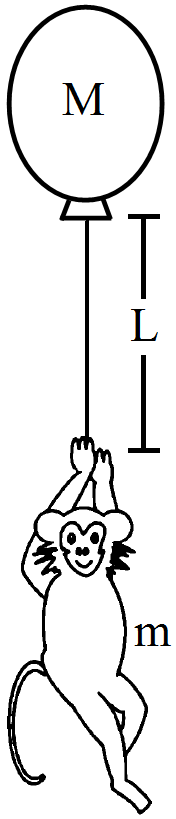
The balloon, the light rope and the monkey shown in figure are at rest in the air. If the monkey reaches the top of the rope, by what distance does the balloon descend ? Mass of the balloon = M, mass of the monkey = m and the length of the rope ascended by the monkey = L.
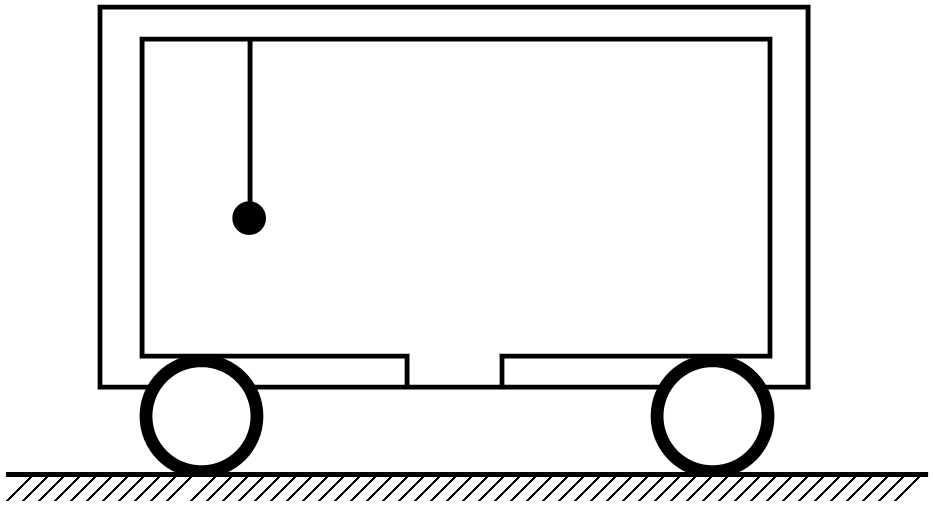
A cart of mass M is at rest on a frictionless horizontal surface and a pendulum bob of mass m hangs from the roof of the cart. The string breaks, the bob falls on the floor, makes several collisions on the floor and finally lands up in a small slot made in the floor. The horizontal distance between the string and the slot is L. Find the displacement of the cart during this process.
Draw the following graphs for an object under free fall :
  1. Variation of acceleration with respect to time.
  2. Variation of velocity with respect to time.
  3. Variation of distance with respect to time.