Question
Explain with a neat circuit diagram. How you will determine the unknown resistances using a meter bridge.

Answer

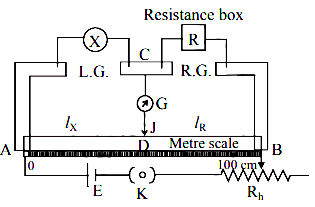
Construction:
i. Metrebridge consists of a one-metre long wire of uniform cross-section, stretched on a metre scale which is fixed on a wooden table.
ii. The ends of the wire are fixed below two $L$ shaped metallic strips. A single metallic stripe separates the two L-shaped strips leaving two gaps, left gap and right gap.
iii. iii. Usually, an unknown resistance $X$ is connected in the left gap and a resistance box is connected in the other gap.
iv. One terminal of a galvanometer is connected to point $C$ on the central strip, while the other terminal of the galvanometer carries the jockey (J). Temporary contact with the wire $A B$ can be established with the help of the jockey.
v. A cell of emf E along with a key and a rheostat is connected between points $A$ and $B$.

Working:
i. A suitable resistance $R$ is selected from the resistance box.
ii. The jockey is brought in contact with $A B$ at various points on the wire $A B$ and the balance point (null point), $D$ is obtained. The galvanometer shows no deflection when the jockey is at the balance point (point $D$ ).
iii. Let the respective lengths of the wire between $A$ and $D$, and that between $D$ and $C$ be $I_x$ and $I_R$.
iv. Then using the balancing conditions,
$\frac{ X }{ R }=\frac{ R _{ AD }}{ R _{ DB }} \text {. }$
where $R_{A D}$ and $R_{D B}$ are a resistance of the parts $A D$ and $D B$ of the wire respectively.
$v$. If $I$ is the length of the wire, $\rho$ is its specific resistance, and $A$ is its area of cross-section then
$ R _{ AD }=\frac{\rho l_{ x }}{ A }$
$R _{ DB }=\frac{\rho l_{ R }}{ A } $
From equations (1), (2) and (3),
$ \frac{ X }{ R }=\frac{ R _{ AD }}{ R _{ DC }}=\frac{\rho l_{ x } / A }{\rho l_{ R } / A }$
$\therefore \frac{ X }{ R }=\frac{l_{ x }}{l_{ R }}$
$\therefore X =\frac{l_{ x }}{l_{ R }} R $
Thus, knowing $R, I_x$ and $I_R$, the value of the unknown resistance can be determined.

Need a full question paper?

Generate a complete, print-ready paper with questions like this in minutes — across 16+ boards, with answer keys.
Start Generating Free

Similar questions

Two soap bubbles $A$ and $B$, of radii $2 \mathrm{~cm}$ and $4 \mathrm{~cm}$, respectively, are in a closed chamber where air pressure is maintained at $8 \mathrm{~N} / \mathrm{m}^2$. If $\mathrm{n}_{\mathrm{A}}$ and $\mathrm{n}_{\mathrm{B}}$ are the number of moles of air in bubbles $A$ and $B$, respectively, then find the ratio $n_B: n_A$. [Surface tension of soap solution = $0.04 \mathrm{~N} / \mathrm{m}$. Ignore the effect of gravity.]
A uniform solid sphere has radius \(0.2 m\) and density \(8 \times 10^3 kg m ^3\). Find the moment of inertia about the tangent to its surface. \((\pi=3.142)\)
A Rectangular coil of $10$ turns, each of area $0.05\ m^2,$ is suspended freely in a uniform magnetic field of induction $0.01\ T. A$ current of $30\ µA$ is passed through it.
(i) What is the magnetic moment of the coil?
(ii) What is the maximum torque experienced by the coil?
A horizontal disc is rotating about a transverse axis through its centre at $100 \mathrm{rpm}$. A $20 \mathrm{gram}$ blob of wax falls on the disc and sticks to it at $5 \mathrm{~cm}$ from its axis. The moment of inertia of the disc about its axis passing through its centre is $2 \times 10^{-4} \mathrm{~kg} \cdot \mathrm{m}^2$. Calculate the new frequency of rotation of the disc.
State the expression for the energy stored in'the magnetic field of an inductor. Hence, define its self inductance.
In a cyclotron protons are to be accelerated. Radius of its D is $60\ cm$. and its oscillator frequency is $10\ MHz$. What will be the kinetic energy of the proton thus accelerated?
(Proton mass $= 1.67 \times 10^{-27} kg, e = 1.60 \times 10^{-19} C, 1eV = 1.6 \times 10^{-19} J$)
A gas contained in a cylinder fitted with a frictionless piston expands against a constant external pressure of 1 atm from a volume of 5 litres to a volume of 10 litres. In doing so it absorbs 400 J of thermal energy from its surroundings. Determine the change in internal energy of system. 
Name two materials that have negative magnetic susceptibility.
A liquid of density $900 \mathrm{~kg} / \mathrm{m}^3$ rises to a height of $9 \mathrm{~mm}$ in a capillary tube of $2.4 \mathrm{~mm}$ diameter. If the angle of contact is $25^{\circ}$, find the surface tension of the liquid.
A certain string $500 \mathrm{~cm}$ long breaks under a tension of $45 \mathrm{~kg}$ wt. An object of mass $100 \mathrm{~g}$ is attached to this string and whirled in a horizontal circle. Find the maximum number of revolutions that the object can make per second without breaking the string, $\left[\mathrm{g}=9.8 \mathrm{~m} / \mathrm{s}^2\right.$ ]