Question
Explain with an example, how genes control the characteristics (or traits).

Answer

The characteristics or traits in animals and plants are controlled by genes. For example the transmission of color of hair from the parents to the child. If a mother has black hair and the father has blonde hair and the child has black hair then the transmission of genes for hair colour from the mother and father to the child is as follows: Mother’s cell contains two genes HH for black hair. Both the genes HH are dominant genes, so the mother has black hair. Father’s cell contains two genes (hh) for blonde hair. The two genes hh are recessive genes, so the father has blonde hair. Now, during the process of reproduction, the mother transmits one of the dominant genes H for black hair to the child and the father transmits one of his recessive genes h for blonde hair to the child. Due to this, the child has the genes Hh for her hair. Now the gene H for black hair is the dominant gene but the gene h for blonde hair is the recessive gene. The dominant gene H for black hair shows its effect due to which the child has black hair.
Need a full question paper?

Generate a complete, print-ready paper with questions like this in minutes — across 16+ boards, with answer keys.

Start Generating Free

Similar questions

An object 4.0cm in size, is placed 25.0cm in front of a concave mirror of focal length 15.0cm.
  1. At what distance from the mirror should a screen be placed in order to obtain a sharp image?
  2. Find the size of the image.
  3. Draw a ray diagram to show the formation of image in this case.
If a concave mirror has a focal length of 10cm, find the two positions where an object can be placed to give, in each case, an image twice the height of the object.
Name the conducting structures present in plants.
What substances are contained in pancreatic juice? What are their functions?
What constitutes the central and peripheral nervous systems? How are the components of central nervous system protected?
One-half of a convex lens of focal length 10cm is covered with a black paper. Can such a lens produce an image of a complete object placed at a distance of 30cm from the lens? Draw a ray diagram to justify your answer. A 4cm tall object is placed perpendicular to the principal axis of a convex lens of focal length 20cm. The distance of the object from the lens is 15cm. Find the nature, position and size of the image.
A, B and C are three common STDs. A and C are caused by bacteria whereas B is caused by a virus D. The virus D reduces the immunity of the infected person to such a low level that the person can die of even very mild diseases.
  1. What could A and C be?
  2. What is B?
  3. Name the virus D?
  4. How can A, B and C be caused?
  5. Out of A, B and C, which one does not have a definite cure as yet?
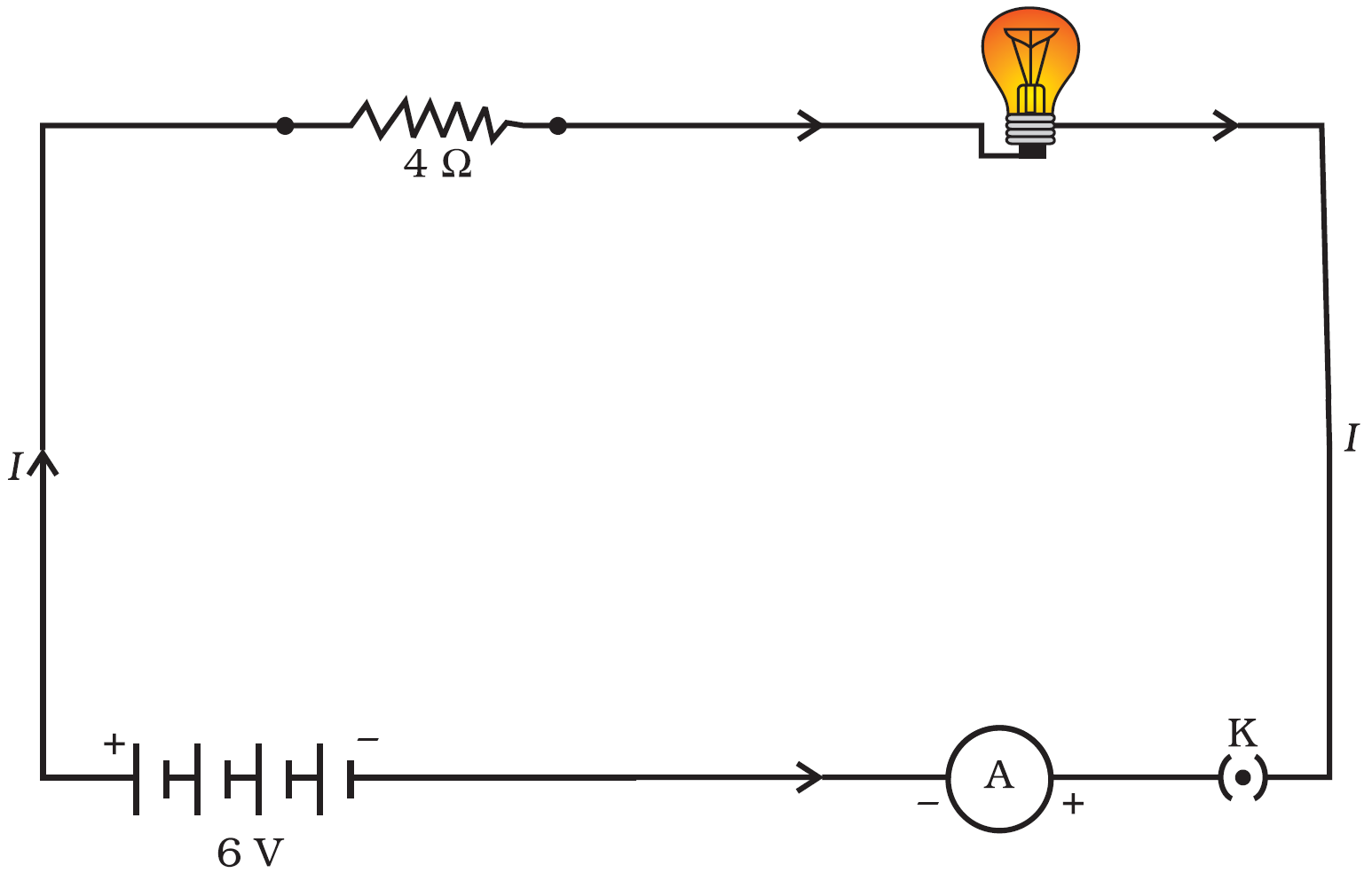
An electric lamp of resistance $20\Omega$ and a conductor of resistance $4\Omega$ are connected to a 6V battery as shown in the circuit. Calculate:
  1. The total resistance of the circuit,
  2. The current through the circuit,
  3. The potential difference across the (i) electric lamp and (ii) conductor, and
  4. Power of the lamp.
Name the four main stakeholders in the management of forest resources.
What is lymphatic system? What are its functions?