Cost Of Production and Concept of Revenue — Economics STD 11 Commerce — Question
Gujarat BoardEnglish MediumSTD 11 CommerceEconomicsCost Of Production and Concept of Revenue5 Marks
Question
Explain with diagram the inter-relationship between average cost and marginal cost.
✓
Answer
Inter-relationship between Average Cost and Marginal Cost:
The relationship between the average cost and the marginal cost is quite important for studying production cost.
We know that cost per unit of output is called Average Cost $(AC)$ and the cost increased to produce one extra unit of commodity is called the Marginal cost $(MC)$.
A producer in long run decides to continue production if:
Price of a commodity is more than its Average Cost $(AC)$.
On the other hand, in short run, the producer decides to continue production if:
Price of commodity is more than Marginal Cost $(MC)$.
Thus, the Average Cost $(AC)$ and the Marginal Cost $(MC)$ play important role in taking a decision about production.
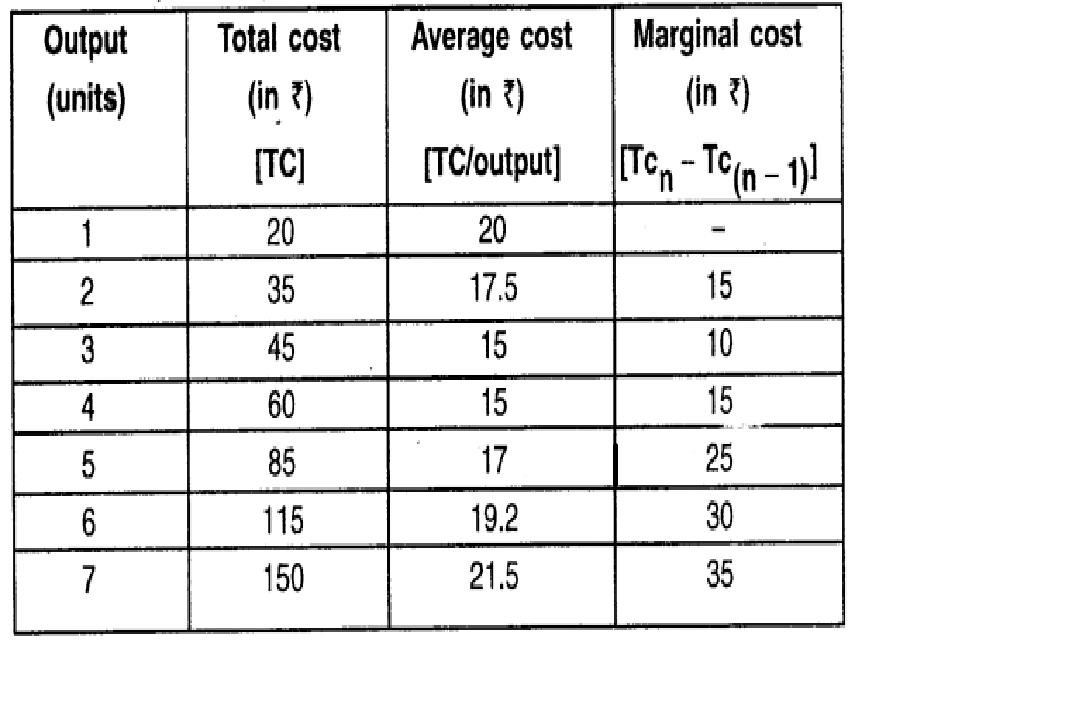
Example :
The table below shows Total cost, Average Cost and Marginal Cost of a firm for an output of a particular commodity. Average Cost $(AC)$ and Marginal Cost $(MC)$ are shown on $Y-$axis and their curves are plotted.Relation between $AC$ and $MC: 1.$ Marginal Cost < Average Cost $(MC < AC)$: Initially, as average cost decreases marginal cost also decreases but, marginal cost decreases more rapidly than the Average Cost. Hence, when marginal cost is decreasing its curve remains below the curve of average cost i.e. $MC < AC.$ Marginal Cost = Average Cost $(MC = AC)$:
When Average Cost is minimum, the Marginal Cost curve intersects the Average Cost curve from below. At the point of intersection the Marginal Cost and Average Cost become equal i.e. $MC = AC.$ Marginal Cost > Average Cost $(MC > AC)$: When Marginal Cost curve intersects the Average Cost curve, both the costs start increasing.
After this point increase in Marginal Cost is rapid than the increase in Average Cost. Hence, Marginal Cost curve goes above Average Cost curve i.e. $MC > AC.$
As shown in the schedule, as output increases, initially the Average Cost $(AC)$ and the Marginal Cost $(MC)$ both decrease upto 3rd unit produced because of the law of increasing returns to scale is applicable.
At the 4th unit of output Average Cost and the Marginal Cost both become equal. Moreover, $AC$ is minimum at 4th unit.
After this point due to the decrease returns to scale law, both $AC $ and $MC$ increase. Diagram of relationship between average cost and marginal costDiagram: The output unit is shown on $X-$axis.
Need a full question paper?
Generate a complete, print-ready paper with questions like this in minutes — across 16+ boards, with answer keys.