Question
Explain with examples the terms weak and strong electrolytes.

Answer

Weak electrolytes$:$ Weak electrolytes are those which do not dissociate into ions completely in aqueous solution $e.g.$ $CH_3COOH$
Strong electrolytes$:$ Strong electrolytes are those which dissociate into ions completely in aqueous solution $e.g. NaCl$

Need a full question paper?

Generate a complete, print-ready paper with questions like this in minutes — across 16+ boards, with answer keys.

Start Generating Free

Similar questions

An organic compound ‘A’ with molecular formula $C_5H_8O_2$ is reduced to n pentane on treatment with Zn–Hg/ HCl. ‘A’ forms a dioxime with hydroxylamine and gives a positive lodoform test and Tollens’ test. Identify the compound A and deduce its structure.
Short note on: Sucrose.
Match the defects given in Column I with the statements in given Column II.
  Column I   Column II
(i)
Simple vacancy defect
(a)
Shown by non-ionic solids and increases density of the solid.
(ii)
Simple interstitial defect
(b)
Shown by ionic solids and decreases density of the solid.
(iii)
Frenkel defect
(c)
Shown by non ionic solids and density of the solid decreases.
(iv)
Schottky defect
(d)
Shown by ionic solids and density of the solid remains the same.
 
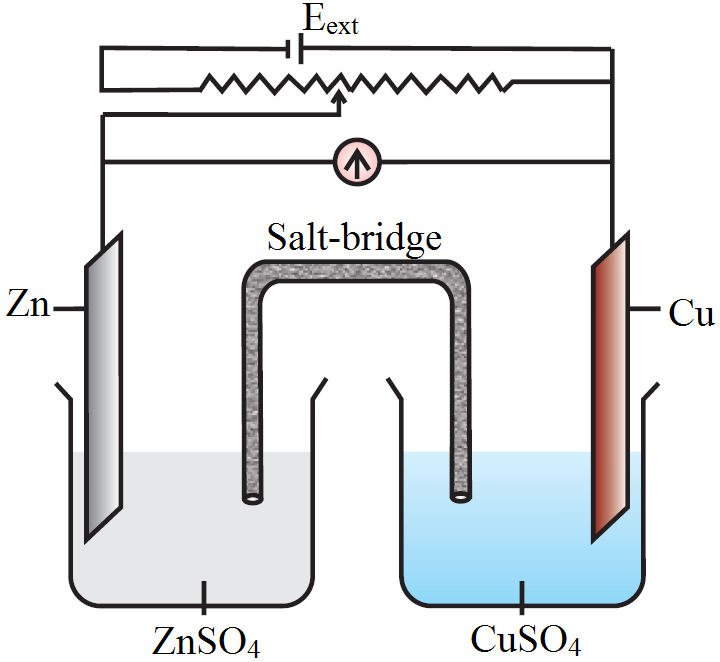
The electrochemical cell given alongside converts the chemical energy released during the redox reaction
$\text{Zn(s) + Cu}^{2+}\text{(aq)}\xrightarrow{ \ \ \ \ \ \ \ }\text{Zn}^{2+}(\text{aq) + Cu(s)}$
to electrical energy. It gives an electrical potential of $1.1V$ when concentration $Zn^{2+}$ and $Cu^{2+}$ ions is unity. State the direction of flow of current and also specify whether zinc and copper are deposited or dissolved at their respective electrodes when:
  1. An external opposite potential of less than $1.1V$ is applied.
  2. An external potential of $1.1V$ is applied.
  3. An external potential of greater than $1.1V$ is applied.
If one strand of a DNA has the sequence -ATGCTTCA-, what is the sequence of the bases in the complementary strand?
Square complexes of $MX_2A_2$ type with coordination number of $4$ exhibit geometrical isomerism whereas tetrahedral complexes with similar composition do not. Why?
Explain the difference between instantaneous rate of a reaction and average rate of a reaction.
Answer the following questions:
Draw the geometrical isomers of complex$[Pt(NH_3)_2Cl_2]$.
Iron has a body centred cubic unit cell with a cell edge of 286.65 pm. The density of iron is $7.87\ g\ cm^{–3}.$ Use this information to calculate Avogadro’s number $($At mass of $Fe = 56\ g\ mol^{–1}).$
Define the following:
  1. Cationic detergents
  2. Narrow spectrum antibiotics
  3. Disinfectants